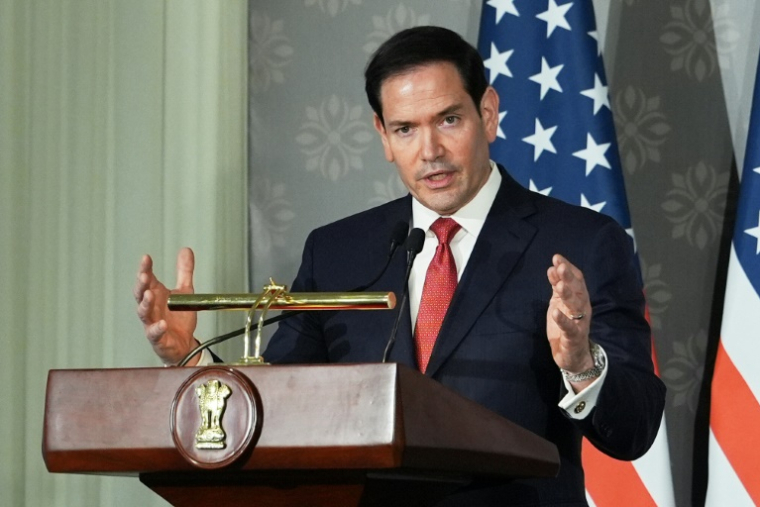
Marco Rubio, during a press conference in New Delhi, May 24, 2026. (POOL / Julia Demaree Nikhinson)
Donald Trump on Sunday tempered hopes of an imminent agreement with Iran to permanently end the war in the Middle East, despite signs of progress on both sides.
“I asked my representatives not to rush to conclude an agreement, because time is on our side,” wrote the American president on his Truth Social platform, also warning that the blockade imposed by his country on Iranian ports would remain in force “until an agreement is concluded, certified and signed”.
A senior American official, cited by Axios, for his part indicated that the White House did not expect the agreement to be sealed on Sunday. The presidency “believes that approval of the agreement by the Iranian authorities could take several days”, according to the media.
Triggered on February 28 by an American-Israeli attack on Iran, the conflict spread to a large part of the Middle East and left thousands dead, especially in Iran and Lebanon where the pro-Iranian movement Hezbollah joined the hostilities in early March by targeting the territory. Israeli.
A ceasefire has been in force since April 8 between Iran and the United States, but the world economy continues to be shaken by the virtual blockade of the strategic Strait of Hormuz at the initiative of Iran for almost three months.
“If I make a deal with Iran,” Donald Trump said in a new message on Sunday, “it will be a good, serious deal, not like the one made by (Barack) Obama,” referring to the 2015 nuclear deal negotiated by the former Democratic president and which he retired during his first term.
The Republican leader thus seemed to respond to the criticism expressed this weekend in his own camp regarding an agreement which would be favorable to Iran.
According to American media, this agreement would allow ships to once again pass through Hormuz, a passage through which a fifth of the hydrocarbons consumed in the world before the conflict transited.
– What about nuclear? –
According to CBS News, citing sources close to the discussions, the latest proposal would also include the unfreezing of certain Iranian assets in banks abroad.
“Despite discussions started today (Sunday), the United States continues to block certain clauses of the agreement, in particular the question of the release of frozen Iranian assets, and these points remain unresolved at this time”, however indicated the Tasnim press agency at the end of the day.
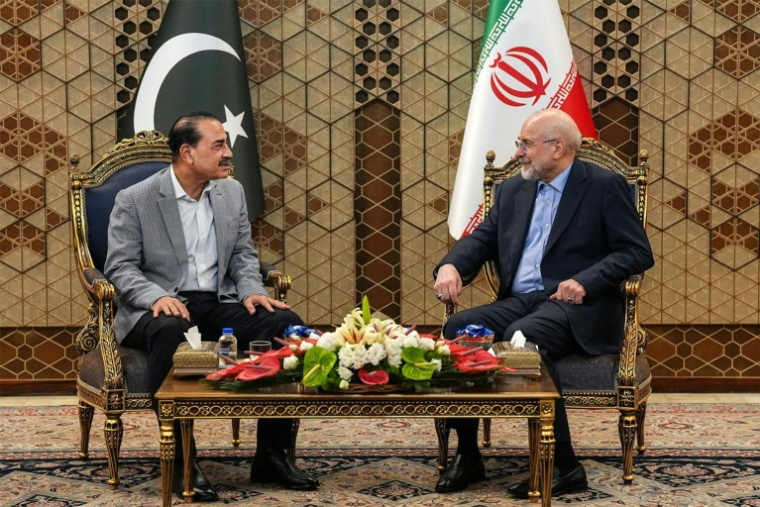
Photo provided by the Islamic Consultative Assembly News Agency (ICANA) shows Iranian Parliament Speaker Mohammad Bagher Ghalibaf (R) and Pakistan Army Chief Asim Munir in Tehran on May 23, 2026 (ICANA NEWS AGENCY / -)
Fars reports that sanctions targeting oil, gas and other petrochemical products would also be lifted while negotiations continue to allow Iran to export these products, which are essential for its economy.
The agreement discussed, however, does not seem to resolve the nuclear issue.
““Nuclear negotiations are highly technical issues. You can’t settle a nuclear issue in 72 hours on a corner table,” US Secretary of State Marco Rubio told the New York Times from New Delhi.
Once the reopening of the Strait of Hormuz has been achieved, “we will begin, according to agreed terms, very serious negotiations on enrichment, on highly enriched uranium and on their commitment never to acquire nuclear weapons”, he said, referring in this regard to a “60 day” period.
Israeli Prime Minister Benjamin Netanyahu said on Sunday that he had agreed with Mr. Trump that any final agreement with Iran must “entirely eliminate the nuclear threat”, according to a press release after a telephone interview on Saturday evening between the two allies.
Pakistani Prime Minister Shehbaz Sharif, mediator in these negotiations, fueled the scenario on Sunday of a resolution of the conflict in several stages, declaring that he hoped to “welcome the next negotiation session very soon”. A first was held in Islamabad on April 11, without an outlet.
– “Right to defend oneself” –
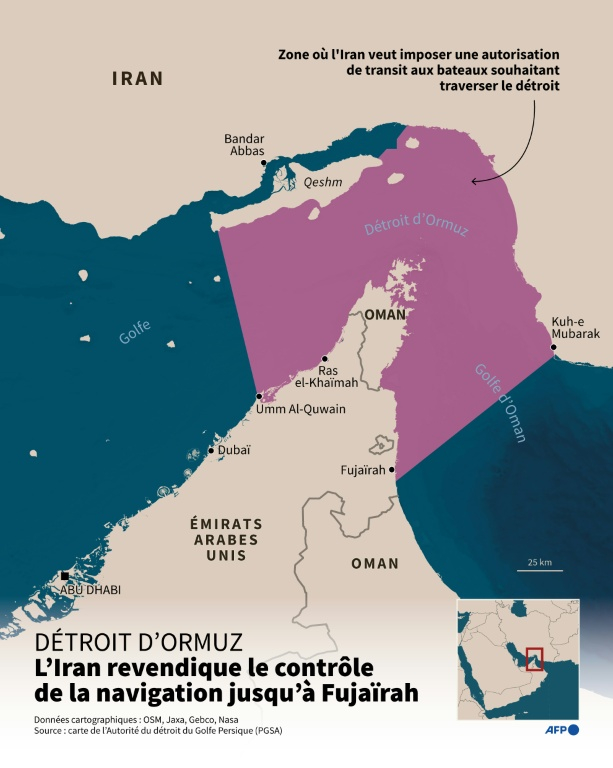
Map showing the area where Iran wants to impose a transit authorization on boats wishing to cross the strait, to Fujairah, in the United Arab Emirates on the east side, according to a document published Wednesday by the new Persian Gulf Strait Authority (PGSA) (AFP / Valentina BRESCHI)
On the Lebanese front, two people were killed on Sunday by Israeli strikes, the day after an Israeli raid which left 11 dead, announced the Ministry of Health, despite the truce in progress since April 17.
Mr. Netanyahu said on Sunday that Donald Trump had, during his telephone call, reiterated Israel’s “right” to defend itself on all fronts, particularly in Lebanon, while the leader of Hezbollah, Naïm Qassem, said he hoped that the agreement between Washington and Tehran would include his country.
But the leader of the Shiite movement also once again rejected the direct negotiations of the Lebanese government with Israel, a fourth session of which is planned for early June in Washington, and repeated that disarmament of his organization, demanded by the Lebanese authorities, would bring to fruition an “Israeli project”.
The head of American diplomacy accused the pro-Iranian movement of wanting to “plunge Lebanon back into chaos”.