Decathlon is celebrating its 50th anniversary this year. How is the company celebrating this anniversary?
This anniversary takes on a very special dimension for Decathlon, particularly in France, its historic birthplace. Rather than focusing celebrations on a single event, we have chosen to mark this anniversary over the long term, as a real red thread that punctuates the whole year. This approach allows us to give depth and meaning to this celebration, avoiding the “one shot” effect. It also reflects our desire to make this anniversary a living, embodied and shared experience, first and foremost with those who make Decathlon every day: our employees. We also have a strong editorial bias: not to adopt a reading exclusively focused on the past, nor to project only towards the future. The ambition is to create a balanced story, capable of linking heritage, present and vision. It is in this spirit that the signature was born “50 years of shared adventures”, which embodies both our collective history, our culture of sport accessible to all and our dynamic of continuous innovation.
How is the brand’s voice articulated?
We have built our communication system around a three-part narrative: the past, the present and the future. The idea is to offer a complete and coherent story, capable of tracing the history of Decathlon since the opening of its first store in 1976, while highlighting what the company has become today and the ambitions that carry it for tomorrow. Internally, this narrative line is embodied by what we call the “blue thread.”. It is a structuring benchmark, both educational and unifying. It makes it possible to pass on the company’s heritage to new generations of employees, while valuing those who contributed to building it – some have more than 40 years of seniority. This intergenerational link is essential: it nourishes the corporate culture and reinforces the feeling of belonging.
How does this “blue thread” translate concretely among employees?
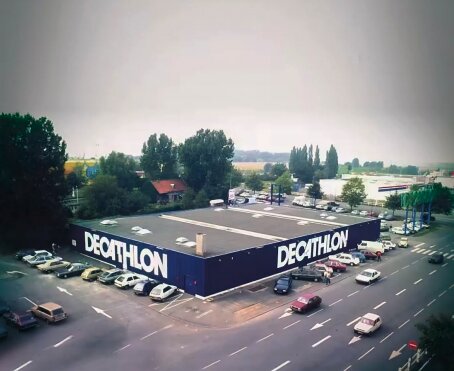
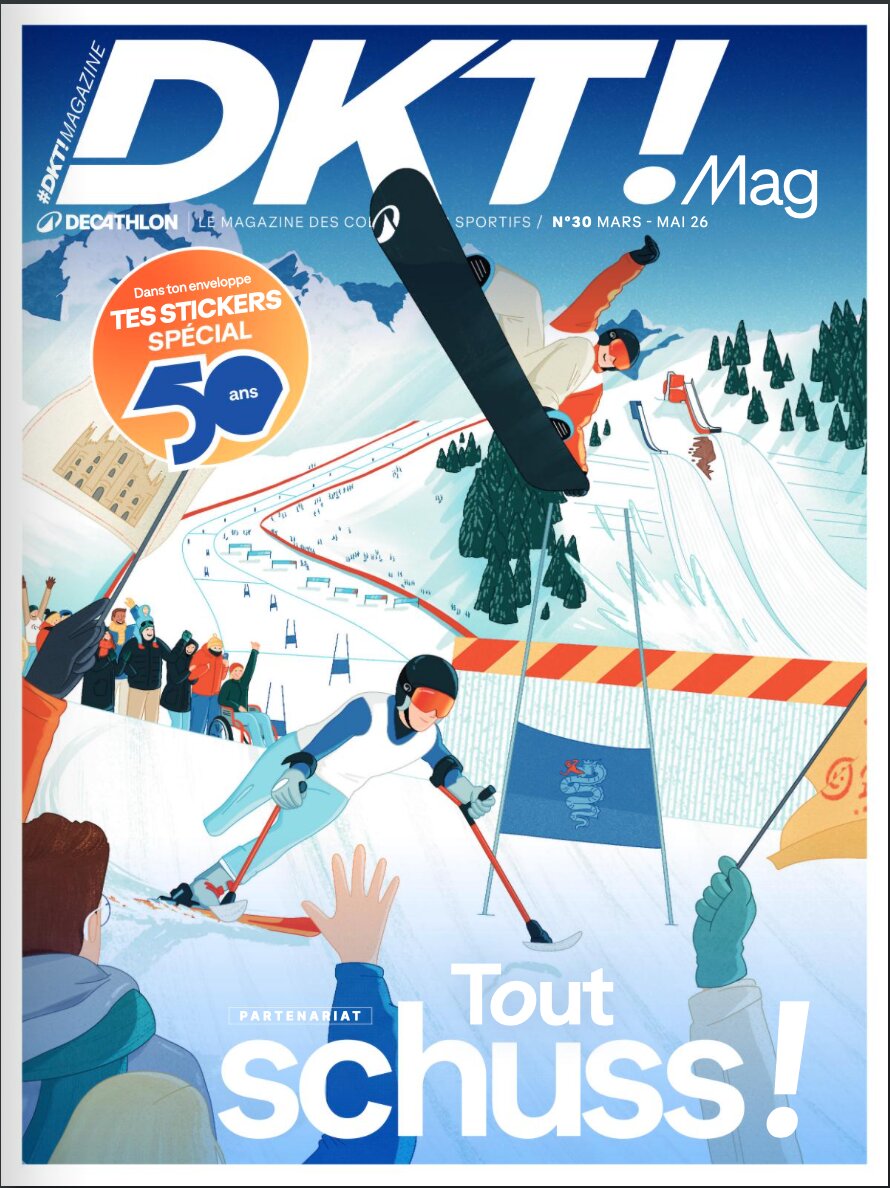
It is firstly expressed through our historical internal channels which constitute the basis of our communication: a newsletter, Good News, an emblematic print magazine, DKT Mag ! – which has existed for more than twenty years – as well than an internal radio, Radio Carpetlaunched seven years ago to reach teams on the ground more directly. But on the occasion of the 50th anniversary, we wanted to take a new step by offering more experiential and immersive formats. One of the flagship devices is the « Van Tour », a vehicle in the colors of the anniversary which crisscrosses France in twelve stages. This traveling project allows us to meet the teams as close as possible to their daily lives.
What experience is offered there?
Inside the van, we imagined a mini-museum which showcases emblematic products and recounts the evolution of the brand, but also a podcast studio. Employees can record their testimonials, share their memories, tell their own adventure with Decathlon. The van is installed directly in parking lots or near stores, transforming these everyday places into spaces of experience and transmission. Teams are invited to discover the exhibition and actively contribute to the collective story. Our ambition is to make the brand’s story tangible, alive and embodied.
Will there still be a highlight, an official date for the anniversary?
Yes, we are planning an internal celebration in June. The challenge is to offer a collective, unifying experience accessible to all, reflecting Decathlon’s DNA. However, this meeting does not constitute an isolated highlight. It is fully in line with the logic that we have defined from the start: that of a birthday that is experienced over time.
More broadly, what place do events occupy in Decathlon’s internal communication?
I am deeply convinced that this is a particularly powerful lever for sustainably engaging employees. Where certain formats inform, the event allows an experience to be lived – and it is precisely this experiential dimension which creates support. At Decathlon, we have long cultivated a true internal event culture, structured at different levels: national, regional, but also local, as close as possible to the field. This translates into the regular organization of conventions, team meetings and even events specific to each store. For example, out of the company’s 325 stores in France, this represents at least two events per year and per site, to which are added regional and national meetings. It is therefore a very dense network, which makes it possible to reach all employees, whatever their function or place of practice.
These highlights are not limited to top-down speeches. They are designed as real moments of sharing, where we come to decipher the company’s strategy, give meaning to the directions taken, but also strengthen the links between the teams. Sport naturally occupies a central place, as do moments of conviviality, which fully participate in the overall experience. Basically, for us, events are a key tool to embody the Decathlon culture: a culture based on collective energy, proximity and the pleasure of acting together.
And externally, how does events fit into company communication?
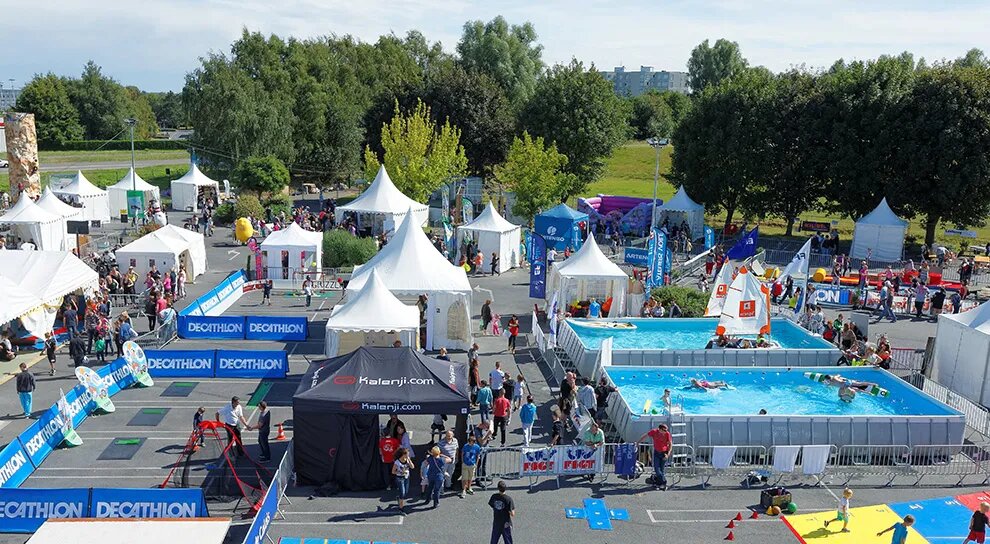
Events also occupy a structuring place in our external communication system. Decathlon is present in a wide variety of formats, which allow us to meet our audiences in various contexts: general public festivals, events dedicated to recruitment – such as the festival My Professional Life – or even local sporting events, like the meeting Vitalsportwhich fully embodies our mission to make sport accessible to all.
The major transformation of recent years is due to a decompartmentalization of our approach. Historically, certain dimensions of communication, such as employer branding, could be treated separately. Today, we have evolved our model towards a much more integrated vision: we now speak in the name of one and the same brand, Decathlon, in all its dimensions. This global approach allows us to offer more coherent and more readable experiences. Whether you are a client, candidate, employee or partner, the objective is to experience a homogeneous interaction with the brand, based on the same values, the same commitments and the same level of requirements.
Events thus become a strategic point of contact, at the intersection of several issues: visibility, engagement, recruitment and loyalty. It is no longer simply a question of being present, but of creating useful, embodied and memorable experiences, capable of sustainably strengthening the link between Decathlon and all of its audiences.
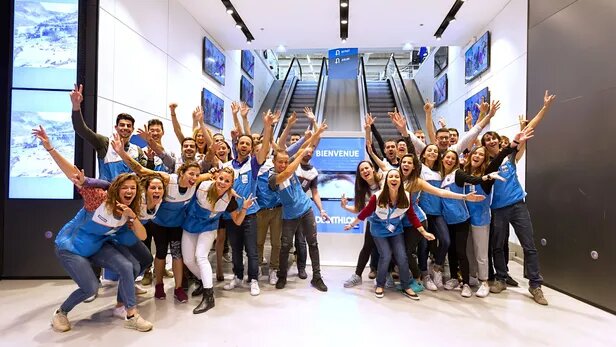
How do you define your employer brand today?
Our employer brand is a direct continuation of Decathlon’s historic DNA: accessibility, generosity and sense of responsibility. These fundamentals are not just stated values, they concretely structure the daily employee experience. This year, we wanted to strengthen and clarify this approach by organizing it around three complementary axes.
The first axis relies on our employees themselves. We launched an employee advocacy program called “Portevoix”, which brings together around fifty volunteers. The idea is to give them the means to express themselves freely and authentically about their experience, particularly on platforms like LinkedIn. They are the best brand ambassadors, because they embody the reality on the ground.
The second axis marks a strong return to the field, with an intensification of event actions and physical meetings. In a context where digital has long been predominant, we reaffirm the importance of direct contact, exchange and lived experience.
Finally, the third axis concerns digital. It obviously remains an essential pillar, but we have evolved its role: it is no longer thought of as an isolated channel, but as an integrated component of a global strategy, serving a coherent and fluid experience.
It is essential that what we say outside fully corresponds to what our employees experience inside the company.
Why did you choose to integrate the employer brand into your overall communication?
This development responds above all to a challenge of coherence and fluidity of the experience. Today, we receive around 600,000 applications per yearwhich implies a strong responsibility: that of offering an image faithful to the reality of the company. It is essential that what we say outside fully corresponds to what our employees experience inside. This alignment is all the more strategic as the career paths at Decathlon are often evolving. Many employees change profession, function or scope throughout their career, sometimes several times. In this context, there can be no gap between external storytelling and real experience. By integrating the employer brand into overall communication, we seek precisely to guarantee this coherence, to strengthen the credibility of our discourse and, ultimately, to build a lasting relationship of trust with all of our audiences.
How many recruitments does this represent each year?
Around 15,000 recruitments per year in France, all types of contracts combined, which cover more than 500 professions.
Which profiles are you looking for as a priority today?
We remain faithful to our historic approach to recruitment: we prioritize interpersonal skills above all else. At Decathlon, we start from the principle that technical skills can be acquired and evolve over time, while human qualities – such as a sense of sharing, team spirit or responsibility – constitute the true foundation of lasting success. This belief is deeply rooted in our corporate culture. It guides our choices, whatever the professions or levels of responsibility. We are looking for personalities capable of committing, progressing and contributing to a collective dynamic.
Of course, market developments and the acceleration of digital challenges also lead us to integrate more specialized profiles, particularly in technological, data or e-commerce expertise. But here again, these technical skills only take on their full meaning if they are part of our culture and our values. In reality, it is not a question of opposing expertise and know-how, but of finding the right balance. Our priority remains to recruit employees capable of adhering to our project, of flourishing in it and of evolving over time. It is this combination of skills and mindset that makes the Decathlon model unique – and strong.
Find the entire article on the media L’Evenementiel