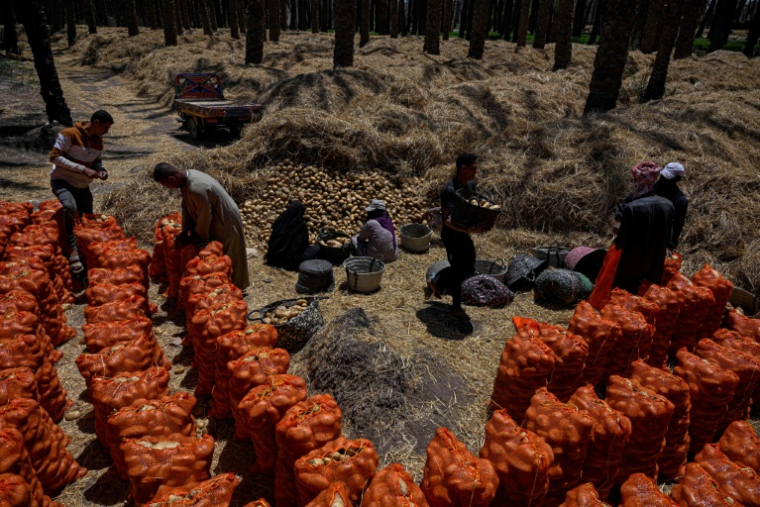
Farmers collect potatoes harvested in a field in the village of Maraziq, south of Giza, on May 4, 2026 in Egypt (AFP / Khaled DESOUKI)
In his corn and sesame field, Achraf Abou Ragab takes stock with bitterness. This Egyptian farmer has had to halve the area he cultivates, victim like other small farmers of the surge in fertilizer prices caused by the war in the Middle East.
“Everything has become more expensive,” assures the 45-year-old man to AFP, in his village of Nazlet al-Shobak, about 50 kilometers south of Cairo. “Fertilizers, seeds, chemicals. Harvests no longer cover their costs.”
Since the start of the war triggered at the end of February by an Israeli-American offensive against Iran, most of its spending has almost doubled. Under these conditions, assures Mr. Abou Ragab, agriculture “no longer pays”. A reality that pushed him to make painful decisions.
Before the conflict, he cultivated an entire acre (about half a hectare) with the help of a small team.
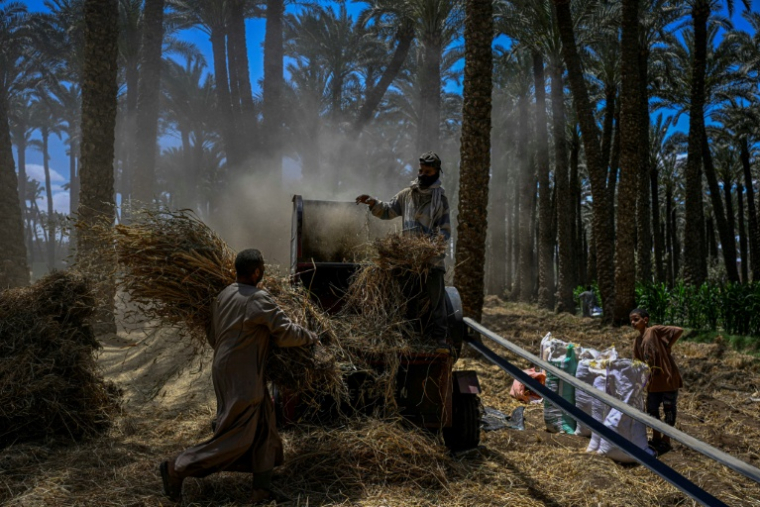
Farmers thresh wheat harvested in a field in the village of Maraziq, south of Giza, on May 4, 2026 in Egypt (AFP / Khaled DESOUKI)
From now on, he only farms half of this area, alone, after dismissing his three workers. He also gave up wheat, a crop that is particularly hungry for fertilizer.
In this agricultural region, the effects of the crisis are visible everywhere. Irrigation pumps remain off for hours to save fuel and some plots have been left fallow.
Observing the results of the harvest, Mohamed Ragab, a 40-year-old sharecropper, appears worried. “I’m barely going to get by,” he confides.
– “Difficult choices” –
Disruptions to maritime traffic in the Strait of Hormuz, a vital artery of global trade, have restricted the supply of energy and fertilizer. About a third of traded fertilizer passes through this waterway, as well as a fifth of the world’s liquefied natural gas and crude oil.
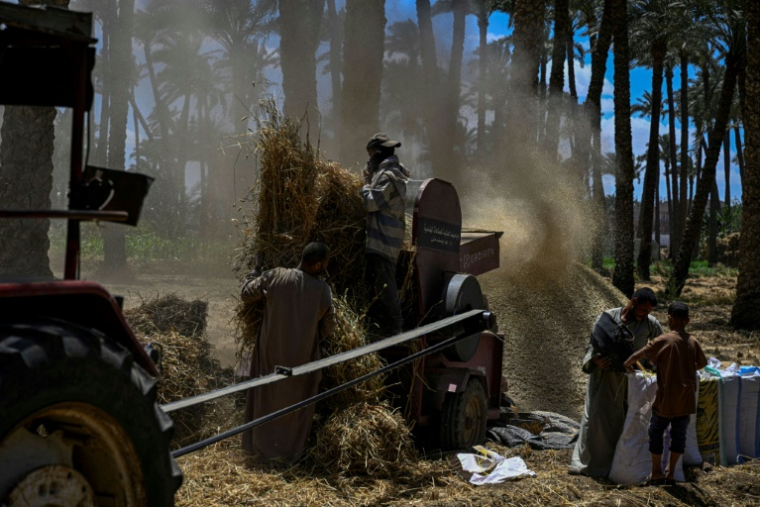
Farmers thresh wheat harvested in a field in the village of Maraziq, south of Giza, on May 4, 2026 in Egypt (AFP / Khaled DESOUKI)
This tension has direct repercussions on the entire agricultural chain, from fertilizer production to irrigation, including the transport of crops.
“Farmers will have to make difficult choices: use fewer inputs, change crops or reduce irrigation, all of which reduce yields,” Maximo Torero, chief economist at the Food and Agriculture Organization of the United Nations (FAO), told AFP.
Although Egypt produces between seven and eight million tonnes of nitrogen fertilizer per year and exports more than half of it, access to the domestic market remains uneven. The country also remains heavily dependent on fuel imports, which particularly exposes it to global energy shocks.
Fuel prices jumped by almost 30% in March and, according to Sherif El-Gebaly, president of the Chamber of Chemical Industries, the price of granulated urea (a nitrogen fertilizer) almost doubled.
– Profits for fertilizer producers –
In a small fertilizer and chemical products store, a trader says he is trying to ease the pressure by buying subsidized products to resell them at prices lower than market prices.
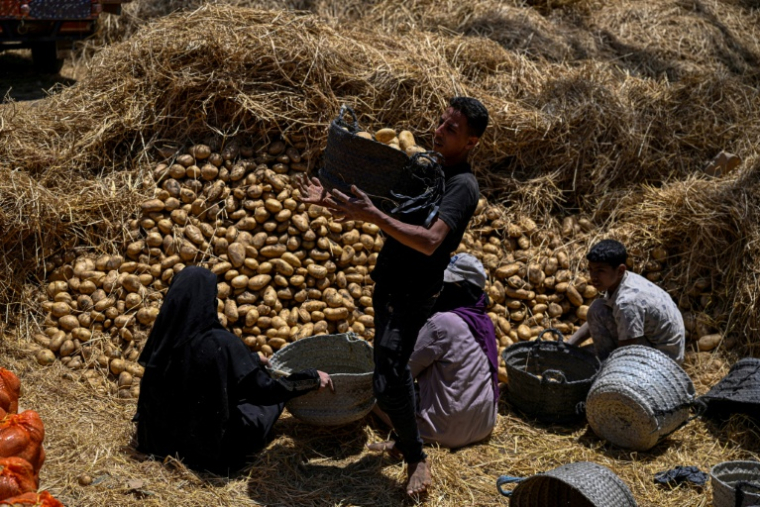
Farmers collect potatoes harvested in the village of Maraziq, south of Giza, on May 4, 2026 in Egypt (AFP / Khaled DESOUKI)
“I try to sell cheaper so that they (farmers, Editor’s note) can continue,” he told AFP, preferring to remain anonymous.
The pressure weighing on farmers contrasts with the situation of fertilizer producers, who are benefiting from rising world prices and strong export demand.
Abu Qir Fertilizers, one of Egypt’s largest nitrogen producers, said its unaudited first-quarter profits more than doubled.
“The coming season will be very difficult (…) If prices remain at this level, many farmers will not be able to continue,” warns Hussein Abou Saddam, president of the Farmers’ Union.
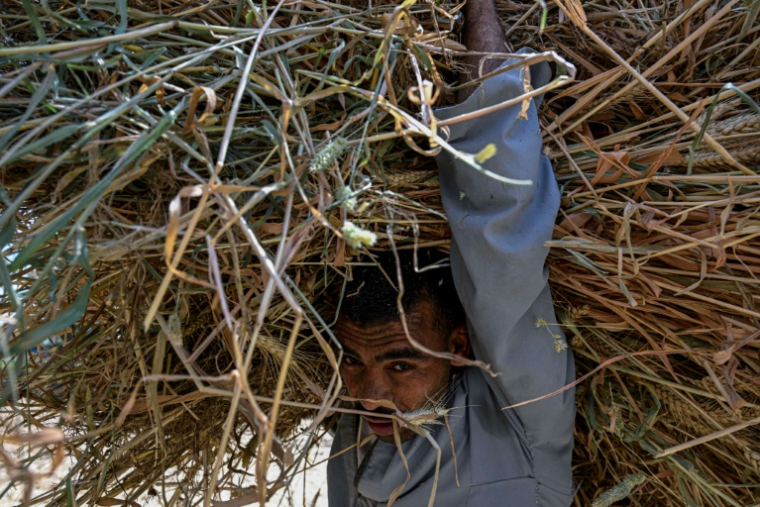
A farmer carries wheat straw in a field in the village of Maraziq, south of Giza, on May 4, 2026 in Egypt (AFP / Khaled DESOUKI)
Wheat represents around a third of cultivated land in Egypt, a crucial issue for the supply of a country which also imports between 12 and 14 million tonnes per year to support its bread subsidizing system.
Maximo Torero of the FAO warns that even if the Strait of Hormuz reopens tomorrow, markets “would take six to eight months to recover.”
If disruptions persist, he adds, “we could be facing a situation similar to that of Covid-19 by the end of the year or next year.”