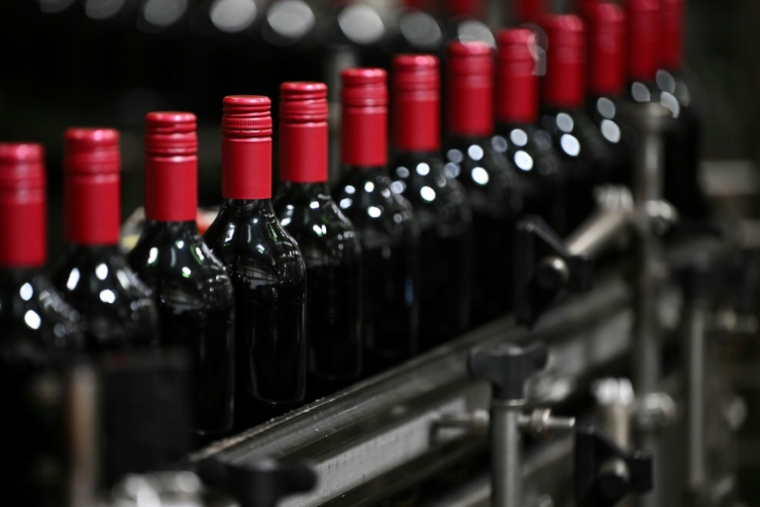
Affected by economic crises but also generational changes, global wine consumption continued to decline in 2025, by 2.7% over one year, to a level not seen since 1957, the International Organization of Vine and Wine (OIV) estimated on Tuesday (AFP / Paul ELLIS)
Affected by economic crises but also generational changes, global wine consumption continued to decline in 2025, by 2.7% over one year, to a level not seen since 1957, the International Organization of Vine and Wine (OIV) estimated on Tuesday.
Wine purchases increased to 208 million hectoliters (mhl), according to the annual report of the interstate organization. Since 2018, global consumption has reduced by 14%.
Of the top ten wine markets, only Portugal saw demand grow last year, driven by national consumption.
Behind this picture, structural changes linked to new preferences and new consumption patterns are at work, but also since Covid purchasing power under pressure and increased costs and prices.
Three countries in particular have fueled this decline: United States, France, China.
The United States, the world’s leading market for a long time “growing and resilient”, is slowing down, with a further -4.3% in 2025 to 31.9 mhl. The OIV sees this as “a combination of economic and behavioral reasons”: less alcohol among young people, diversification in the choice of drinks, price sensitivity, constrained purchasing power…
The impact of the customs duties imposed by Donald Trump is still difficult to isolate in the midst of all these factors, notes John Barker, director of the OIV.
These tariff measures, added to the euro/dollar parity, have affected trade, he says: although “we have seen the American market shrink in volume, in value a little, not so much”.
– “Seize the moment” –
The EU’s leading consumer country, France continues a decline that began decades ago, notes the OIV, with -3.2% (22 mhl) last year.
The EU (48% of world consumption) also sees Italy decline (-9.4%, to 20.2 mhl), Germany, Spain… Outside the EU, Great Britain is declining, like Russia, Switzerland… Brazil and Japan are among the few to consume more.
Finally, China, the eleventh largest consumer in the world when it was 6th in 2020, has continued to reduce its purchases since 2018: 4.8 mhl in 2025, or -13% over one year, -61% since 2020.
Chinese demand “reveals itself to be particularly sensitive to changes in income and prices”, notes the OIV, which also notes that it is transforming, less linked to protocol occasions, more diverse.
Overall, how long can this decline continue?
“The economic factors are really important”, and very significant since post-Covid, notes Mr. Barker, although “difficult to disentangle” from societal changes.
For him, however, the situation is hardly comparable with the level of consumption in 1957, as the mode of wine consumption has changed, from a “volume-driven model” to a model based on value and “premiumization”.
For Ananda Roy, vice-president of Circana, the decline in consumption in Europe and the United States, in addition to a lower interest among young people in alcohol, is due to the price of bottles and the boom in innovative drinks.
This specialist in market trends, who advises producers and distributors, recommends new formats (smaller bottles, “cubis” of quality wines, etc.) as home consumption increases, and to think of “reduced calories and sugar, and little or no alcohol”, the famous “no-lo” wines.
He says he is “optimistic if the sector seizes the moment and innovates beyond the label and the shape of the bottle”.
The OIV does not yet really measure this rise in no-lo: “probably 1 to 2%” of the market, according to Mr. Barker.
“The technology and understanding of this product are developing very quickly,” he notes, also mentioning the growth of sparkling wines, the attention paid to sustainability…
At the same time, global production continues to contract, notably under the effect of climatic hazards.
In 2025, 227 mhl were harvested: this is more than in 2024, a historically low year (+0.6%), but -9.4% compared to the average of the last five years.
What now about a new pitfall with the war in the Middle East?
“It’s a little early to make projections,” notes the manager. But “what we can observe with international events affecting trade is that what affects the cost of living, or transport, has repercussions on the wine market.”