Dans une allocution au ton offensif, Sergueï Lavrov évoque une « ère de changements sans précédent ». Il constate que l'Occident cherche à préserver son hégémonie par tous les moyens tout en freinant l'essor de nouveaux concurrents en Asie, en Afrique et en Amérique latine. Le recours à la force militaire en constituerait l'un des instruments les plus agressifs, citant le Venezuela et l'Iran — le tout en violation flagrante du droit international. Sur l'Ukraine, il affirme qu'« une guerre » a été déclarée à la Russie, que Kiev est un « bélier géopolitique », et pointe l'élargissement de l'OTAN comme cause centrale du conflit, tout en saluant la « franchise » de Donald Trump sur ce point. Voici la retranscription complète de ces propos prononcés lors d'une réunion avec les dirigeants d'organisations à but non lucratif, Moscou, le 24 avril 2026 :
Bonjour,
I’m happy to see you again.
We meet in this form every year. I know that the organizations you represent and the management of our ministry, department directors and their staff, as well as deputy ministers in charge of specific areas, maintain contacts and exchange information.
As is customary at these annual events, we will focus on a frank and interactive discussion around international issues that everyone is aware of and that impact your important and highly valued activities.
If you don’t mind, I will say a few words about our assessment of the latest international developments, and then we will begin the interactive discussion.
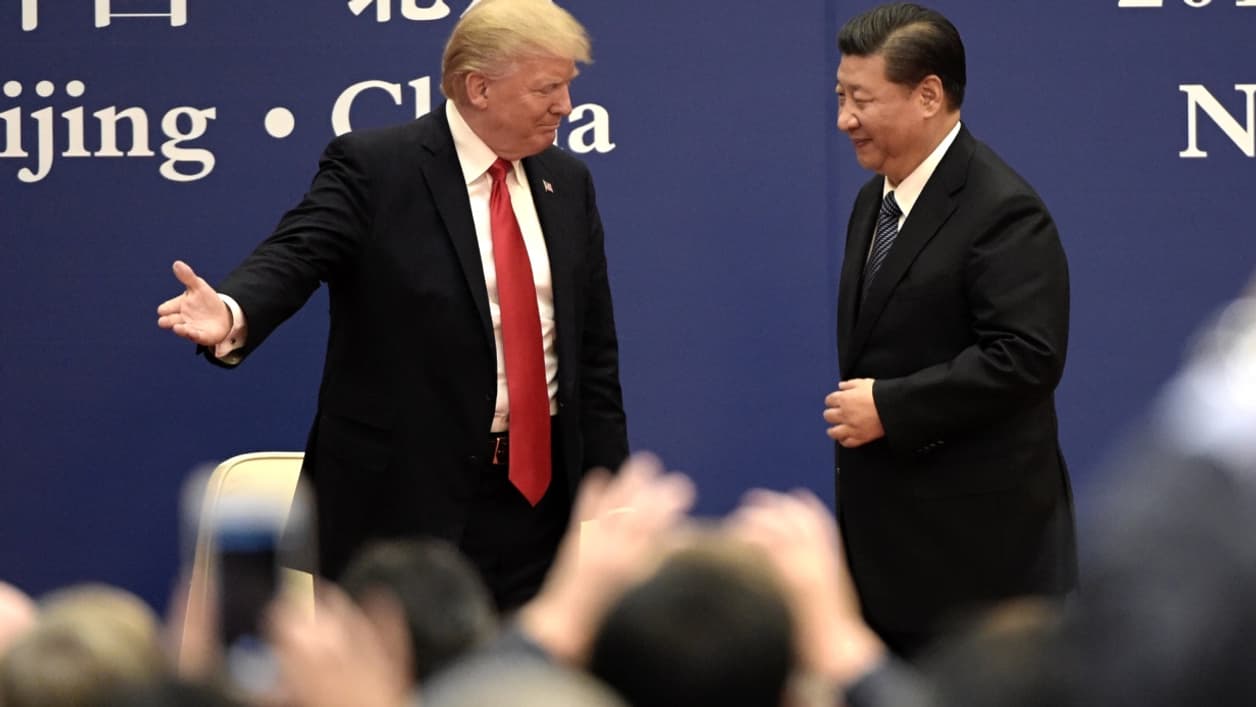
President Putin has repeatedly emphasized that the world has entered an era of unprecedented change. Similar assessments were made publicly by the President of the People’s Republic of China, Xi Jinping. As President Putin noted, in these tumultuous circumstances, Russia, because of its history, geography and civilizational identity, plays a central role in these processes.
As our Chinese friends say, a crisis is an interaction between danger and great opportunities. This is how the world works. Such periods have occurred many times throughout history.
The collective politics of the West constitute the main threat to international peace and security. We continue to describe it as “collective”, although this collective dimension is today torn apart by disagreements. However, their strategic objective, we have no doubt, remains the same: to dominate by all means, to dominate and continue to dominate, and to preserve their hegemony for as long as possible, while containing the growth of new global centers and new competitors in the countries of the world majority in Asia, Africa and Latin America.
Every day we observe, indeed we see in real time, that to preserve their hegemony and achieve these indecent objectives, they resort to illegal sanctions, looting, theft of other countries’ sovereign assets, blackmail, threats and, of course, the use of military force, as we have seen in Venezuela and now in Iran – all in blatant violation of international law.
To say that the unprovoked aggression of the Americans and Israelis against Iran has seriously destabilized the situation in the Middle East is an understatement, because the situation is now destabilizing on a global scale and all countries are reassessing their development prospects economic, their sources of energy supply, etc. The continuation of the conflict (which, it seems, is far from over) will have the most negative repercussions for the entire international community, for the economic situation of the majority of humanity and for global security.
All this does not take place in a vacuum. The decades-long expansion of the West on the Eurasian continent, mainly in regions where Russia has historically exercised strong influence and where it has legitimate traditional interests, is another major factor in global destabilization.
This persistent offensive, which has openly manifested itself in recent years under the slogan of inflicting a strategic defeat on Russia, reflects a long-standing, even, as we see today, centuries-old strategy. At one point in our history, after the creation of the UN and the OSCE, and following the collapse of the Soviet Union, the prospects for coexistence and even cooperation with the West seemed entirely realistic. All this is now a thing of the past.
A war against us has been openly declared. The kyiv regime serves as the spearhead. However, everyone knows that this spearhead is unusable without Western deliveries of weapons, intelligence, satellite systems, training of military personnel, and much more. The kyiv regime and the Ukrainian state are openly used as a geopolitical battering ram. Some rather outspoken personalities, within the Belgian general staff I believe, publicly declared that they were preparing for war with Russia and that Ukraine was helping them to buy time. As they say, it couldn’t be clearer.
In order to justify their policies, the West – above all the international bureaucracy in Brussels (both the EU and NATO, which are increasingly one), as well as Berlin, Paris and, of course, London – is trying to demonize everything Russian and is openly talking about preparing for war against us in the near future. The head of defense of the Belgian armed forces, Frederik Vansina, said that they still have several years left and that Ukraine is buying them time. The same line of thinking was reflected in a statement by German Chancellor Friedrich Merz, when he described Israel’s attack on Iran and, generally speaking, everything Israel does, as if the Israelis were doing the dirty work in their place by fighting Hamas, Hezbollah and other “terrorist” organizations, without taking into account the history of their emergence. This story is directly linked to the categorical refusal to implement the UN decision on the creation of a Palestinian state.
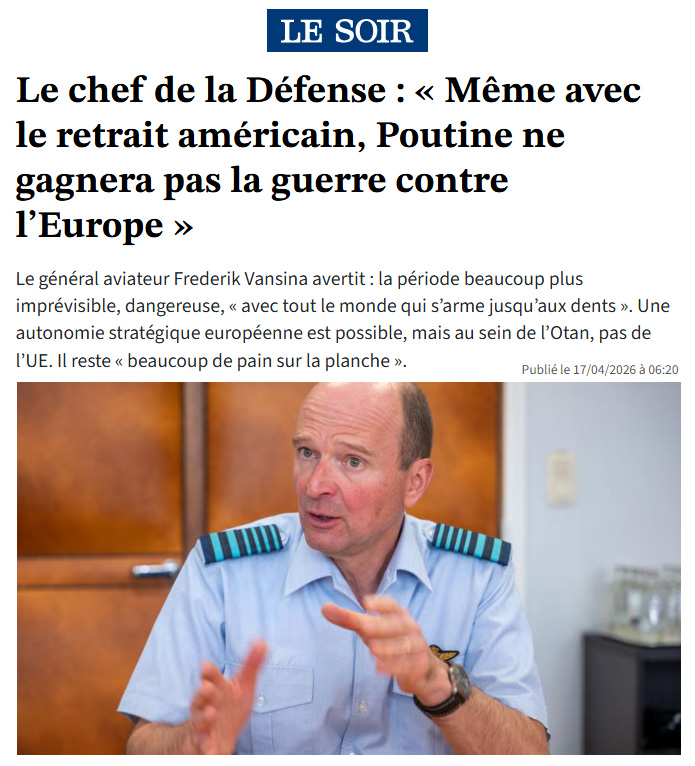
Frederik Vansina : « In 2030, we must be able to tell Vladimir Putin that, even without the Americans, he will not win the war against Europe. We still have a few years ahead of us. Thanks to the courage and blood of the Ukrainians, who buy this time for us. That’s why we support them so much.«Â
Despite the difficult circumstances, we will continue to conduct our foreign policy and defend our vital national interests, creating the most favorable external environment for the sustainable development of our country as a multi-ethnic sovereign state, while strengthening our sovereignty in all areas. This is an almost word-for-word quote from the Foreign Policy Concept, which was updated and approved by the President of Russia in 2023. It remains in force and continues to apply today.
Our priorities include promoting fair and mutually beneficial partnerships with all those willing to cooperate on an equal footing, based on the universally recognized principles of the Charter of the United Nations and international law in general, as well as the search for a fair balance of interests in order to achieve national development goals and strengthen our sovereignty. Our American colleagues are a contrasting example: they defend their national interests as they understand them, and they understand them as their domination, which is currently reflected in their policy aimed at taking control of almost the entire global energy sector. We see it every day.
The logic of the Americans in their relations with most countries (I haven’t heard anyone say it during our exchanges, and I hope I never hear it) is this: if you don’t do what I say, I will punish you. In other words, I don’t promise anything, but you have to give me what I want; and if you don’t, I will punish you. This is not a balancing of interests, and certainly not an honest conversation.
Our policy of defending justice and our categorical rejection of the replacement of international law by such arbitrariness are well understood by the majority of our partners in the South, who also wish to strengthen their sovereignty and establish more equitable international relations, but who are not always able to say it openly because they have been threatened with “sanctions” if they contradicted their more powerful partners.
On the one hand, this simplifies the situation. It’s clear who is who. Many of our political analysts note that President Trump is upfront about his plans; he never fools anyone. He can change his mind frequently and quickly depending on the situation, but he does not hide his rather harsh plans behind rhetorical embellishments that distract from the discussion.
In this struggle (international relations is always a struggle) for justice, for the status and reputation of a country that conducts its affairs honestly, we intend to continue to rely on our public institutions and our non-profit organizations. Indeed, you make a considerable and useful contribution to the implementation of the foreign policy defined by President Putin.
I would like to point out in particular that you represent a minority in terms of numbers, in terms of representation on the international stage within various entities of the UN, the OSCE and other organizations, even if we only consider the West and exclude the popular movements of the South. We can discuss this later today. Of course, Western and pro-Western organizations significantly outnumber those represented here and your colleagues from other countries who share similar approaches.
But we continue to believe that strength lies in truth. It has been said, and those words will never change. And those who impose their “truth” by force are historically doomed to oblivion. We also appreciate the fact that in your international contacts abroad, and when you welcome your colleagues here, you often have discussions based on trust with your international partners. This also helps, including with countries (we would like to move away from the term “hostile countries”) whose governments are currently pursuing hostile policies towards Russia.
Such dialogue based on trust and maintaining an atmosphere of confidentiality aimed at strengthening mutual understanding and developing intercivilizational and intercultural dialogue at the level of civil societies is extremely useful. Its importance continues to grow given the circumstances.
Current geopolitical realities are such that public diplomacy is developing more and more both in the countries of Asia, the Middle East, Africa and Latin America where it already existed, and in those where it has not traditionally played a role in politics foreign.
Conditions for expanding contacts between civil society and non-profit organizations are also created through our interstate work. I am referring to the BRICS, the Russia-Africa Forum which is held regularly, the SCO and the CIS. Within all these entities, a parallel “track-two” type dialogue between representatives of civil society is encouraged. We will do everything possible to strengthen the dialogue with your participation, both on these multilateral platforms and in other forums. The specialized departments of the Ministry of Foreign Affairs, which supervise the SCO, BRICS and the post-Soviet space, are always at your disposal.
I would particularly like to highlight the African dimension. In recent years, relations with our African partners have made great progress in all areas.
I mentioned earlier your colleagues from Western countries. Many of them do not share Russophobia, are well disposed towards Russia, love the Russian language, culture and literature, and share the spiritual and moral values that characterize our multinational society. I also mentioned organizations such as the UN and the OSCE, which work through committees and specialist groups to promote cooperation with civil society. We would be delighted to see more participants join the organizations represented here who already have such an experience.
The dimension of civil society in the G20 agenda also deserves to be highlighted. It represents the most representative sample of the modern world, where the Western countries of the G7 and their allies – Japan and South Korea (ten countries in total) – are represented equally alongside the Second Group of Ten, made up of BRICS countries and our dialogue partners within this format. This opens up promising prospects for the opening of a direct dialogue between the representatives of the world majority and the Western minority.
Ukraine is a subject that interests everyone and is currently the subject of a head-on confrontation between us and Europe. The Americans, of course, seek above all to serve their own interests, but they are the only ones – I have already indicated – to have publicly recognized the existence of the root causes of this conflict. US President Donald Trump has repeatedly claimed that Ukraine should forget NATO, which was one of the main underlying causes of the conflict, despite Ukraine having been prepared, through a series of Maidan events, for blows of state and canceled elections (in 2004), to see its territory used for the deployment of modern high-tech military threats against the security of our country, directly at our borders.
At the same time, the Americans affirm that they are ready to take into account the realities on the ground as they currently present themselves following the referendums. I don’t see anyone else declaring themselves ready to recognize the results of the referendums and the territorial consequences that result from them. They even support the idea that the entire Donbass – the Donetsk and Lugansk regions (no one even thinks about challenging the status of Crimea anymore) – should be recognized as part of the Russian Federation, in accordance with our Constitution.
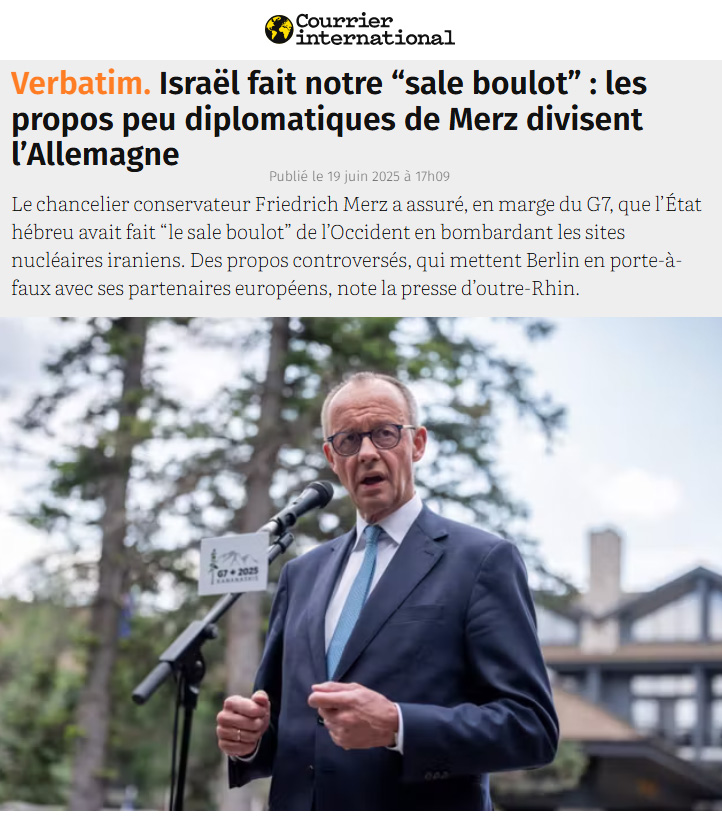
Friedrich Merz: “Israel does the dirty work for us. This diet [iranien] concerns us too. The mullahs’ regime has sowed death and destruction throughout the world, with attacks, murders and assassinations, with Hezbollah, Hamas […] I can only express my greatest respect for the Israeli army and the Israeli government, who had the courage to do this.â€
The West is in the grip of hysteria. Zelensky says he will not leave the Donetsk region, which is part of his security guarantees. In other words, he considers war as part of security guarantees. The West tells him that the priority now is to end the hostilities – simply freeze the situation as it is and provide Ukraine with security guarantees, including, as the French and British dream of, the deployment of multinational stabilization forces. This means one thing: they want to provide security guarantees. security under the Nazi regime.
Zelensky recently visited Cyprus and met with EU representatives to discuss guarantees that would allow him and his clique to remain in power, while keeping in place everything that has become another major underlying cause of the current situation, namely the raging war and the legislative eradication of everything associated with Russia: the Russian language in education, media and culture, as well as the destruction of canonical orthodoxy. This is also part of the civilizational aggression of the West against the Russian Federation, as they planned and began to create civilizational threats on the borders of our then state, right in the heart of the Russian world.
The same type of civilizational aggression was manifested in encouraging the Zelensky regime to eliminate all things Russian and the Ukrainian Orthodox Church. This is also part of the aggression against us, against Russia as a civilization. This is how the West takes advantage of the Nazi regime in Ukraine. When we are told that we should somehow resolve the Donbass issue, and that maybe they will convince Zelensky to make concessions or, maybe, Russia will make concessions and everything will be fine. Nothing will work out. The West has openly declared that it is developing security guarantees for a regime considered a long-term threat to our country and which will be used, among other things, for new military adventures. He said all this would start in the period 2029-2030.
This is why we appreciate the fact that the United States, despite the specificities of its actions, adopts a position consisting of publicly exposing the underlying causes (in an approximation of its real understanding) and – above all – taking concrete measures: no expansion of NATO and respect for the agreements reached at the summit in Alaska. Soon we will celebrate the first anniversary of the Anchorage meeting. During this period, the Europeans – we must recognize their audacity – and Zelensky did everything possible to divert the Americans from the path we had adopted and to continue their maneuvers aimed at destroying a geopolitical competitor.
The Russian language cannot be destroyed. We also see this in Ukraine. The more it is banned, the more it is spoken about, even among representatives of the Zelensky regime during meetings. They are more comfortable speaking Russian than Ukrainian, a language many of them began studying when they entered politics.
In this context, I would like to highlight the creation of an International Organization for the Russian Language at the initiative of the President of Kazakhstan, Kassym-Jomart Tokayev. Last month we held the first IORL Ministerial Conference and outlined the initial phase of this promising new organization. We are counting on your contribution to set up joint events and develop joint projects.
At the same time, as we have done in previous years, we will partner with our non-profit organizations to intensify efforts to counter historical aggression (which is part of the broader framework of civilizational aggression against Russia), to thwart attempts to rewrite the history of the Great Patriotic War and the World War II, and to review the internationally recognized results of our Great Victory.
This year, on April 19, by decree of the President of Russia, the Day of Remembrance of the Victims of the Genocide of the Soviet People was celebrated for the first time – the genocide of all peoples of the USSR committed by the Nazis during the Great Patriotic War. We believe that this date gives us and our friends in non-profit civil society organizations additional impetus to relentlessly pursue justice. We will also seek, including on international platforms, to do recognize as genocide the crimes committed against the Soviet people of all ethnic origins. In this regard, one cannot overestimate the role of patriotic non-profit organizations, which disseminate objective information and implement projects aimed at preserving and perpetuating the memory both within our own nation. than in the nations of Europe that we have liberated.
I would like to conclude by reiterating our commitment to continued cooperation with non-profit organizations in all areas. We supported the initiative of Rossotrudnichestvo and the Russian Association for International Cooperation aimed at establishing in Russia, on April 5, the Day of People’s Diplomacy. This is a landmark event that will undoubtedly become a new focal point to consolidate our efforts and strengthen public diplomacy. We recognize the important role you play in promoting the historical and legitimate interests of our state and in implementing the foreign policy set by the President of Russia.
Source: The Ministry of Foreign Affairs of the Russian Federation