lediplomate.media – printed on 01/05/2026
By Olivier d’Auzon– Discover his latest work at Erick Bonnier:AFRICA 3.0
A “coalition of independents” against the bipolarization of the world
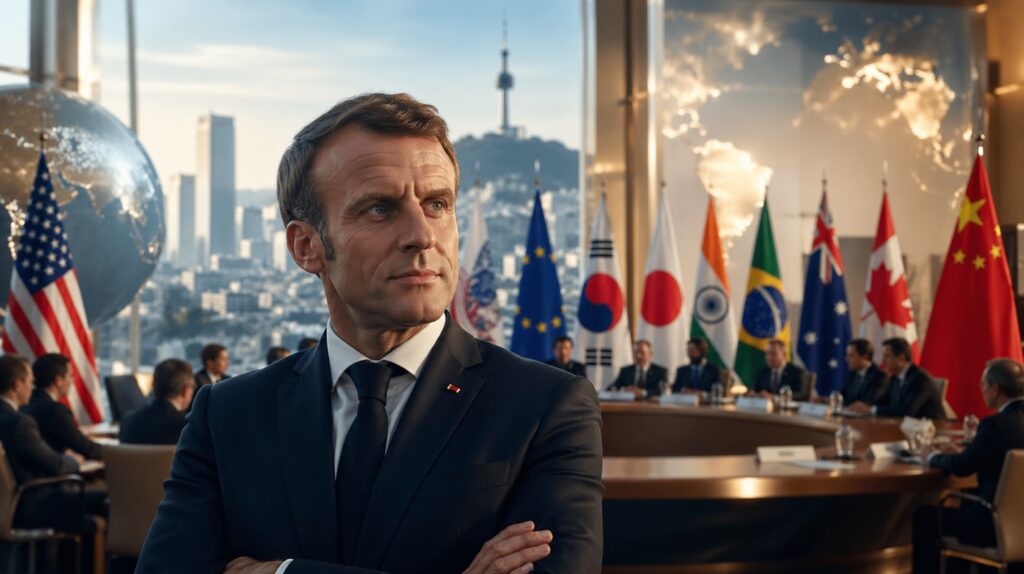
During his trip to South Korea at the beginning of April 2026, Emmanuel Macron put at the heart of the international strategic debate an idea that he had already outlined during theShangri-La DialogueÂ: the formation of a “coalition of independents“, comments journalist Andrew Korybko readily.
The stated objective is clear: to prevent the international system from becoming permanently structured around a Sino-American duopoly. The French president formulated it unambiguously: it is a question of not becoming “the vassals of two hegemonic powers“, neither to depend on China, nor to expose itself excessively to the fluctuations of American politics.
By bringing together actors such as South Korea, Japan, India, Brazil, Australia, Canada and the Europeans around this ambition, Emmanuel Macron is sketching the contours of a “third way ”.
From bipolar totri-multipolarÂ: an evolution of the international system
The implicit diagnosis posed by Paris is that of a world that could be described as “bi-multipolar”: two dominant superpowers – the United States and China – coexist with a plurality of regional or intermediate powers, without these being able to structure the global order on their own.
The French proposal aims precisely to go beyond this configuration to bring about a “tri-multipolar” system. In this diagram, a third force – without being an equivalent superpower – would exert a structuring influence on international balances.
This force would play an adjustment role: by positioning itself between Washington and Beijing, it would help limit their capacity for hegemony, while attracting to it states keen to preserve their strategic autonomy. It would thus participate in the emergence of a more complex international order, sometimes described as “multiplex ”.
Also read: Russo-Western War: Unexpected and Devastating Lessons
Three scenarios for a third force
The notion of tri-multipolarity can be broken down into several configurations.
The first is based on the emergence of a single pivotal state, often envisaged in the form of a “State-civilization“. Some analysts consider that Russia could claim this role, or at least come close to it.
The second hypothesis is based on a structured alliance between great powers. The strategic partnership between Russia and India is sometimes mentioned as a possible basis for such a scenario.
Finally, the third configuration – the most realistic – would be that of a coordination platform between several intermediate or regional powers. Formats like BRICS are regularly cited as embryos of this dynamic.
It is in this latter perspective that Emmanuel Macron’s proposal fits.
An underlying Indian inspiration
However, this approach is not without precedent. It is part of a trend already observable in Indian foreign policy.
This approach is part of a dynamic already at work in India. In an article entitled« India courts middle powers in global diplomatic push », published on 3 mars 2025, le Financial Times stresses that New Delhi is “rapidly deepening its ties with middle powers […] as well as with the European Union »
This practice, without being explicitly theorized as such, corresponds to an operational form of tri-multipolarity. In this sense, the French initiative appears as an attempt to formalize and expand a model already implemented by New Delhi.
India, pivotal state of the new world order
In this context, India occupies a unique position. Through its demographic weight, its economic growth and its strategic autonomy, it has established itself as a central player in the ongoing systemic transition.
Its inclusion in the “coalition of independents“is not trivial: it reflects recognition, by Paris, of the structuring role that New Delhi is likely to play in the international architecture of tomorrow.
This centrality is also perceived by the other great powers. The economic rapprochement between the United States and India, as well as the solidity of Russian-Indian relations, bear witness to this.
Also read: War in Ukraine: French generals against Emmanuel Macron’s position
A determining variable for global balance
From then on, India’s strategic orientation appears to be a determining factor. Depending on whether it comes closer to the United States, Russia or Europe, global balances could evolve significantly.
In this perspective, the “coalition des indépendants” cannot be analyzed independently of the capacity of its members to revolve around a pivotal actor such as India.
Between conceptual ambition and geopolitical constraints
Emmanuel Macron’s proposal presents an undeniable intellectual coherence: it responds to an emerging reality, that of a more fragmented and less hierarchical world.
It nevertheless comes up against several limits. The heterogeneity of interests between the States concerned, the persistence of economic and security dependencies, as well as the absence of structuring institutions, constitute all obstacles to the realization of such a project.
La « third way“outlined by Paris thus appears, at this stage, as a strategic ambition more than a reality in formation.
A correct intuition, an uncertain implementation
Ultimately, the French initiative highlights a central question of our time: how to exist in a world dominated by two great powers without blending into their orbit?
If the response proposed by Emmanuel Macron deserves to be discussed, its implementation will depend less on declarations of intent than on the capacity of the states concerned to transform a convergence of interests into a real political project.
Also read: ANALYSIS – The Horn of Africa between Moscow and Addis Ababa: A partnership that redraws multipolarity
#Geopolitique,#Macron,#TriMultipolaire,#NouvelOrdreMondial,#RelationsInternationales,#ChineVsUSA,#CoalitionDesIndependants,#PuissancesEmergentes,#IndePuissance,#BRICS,#Multipolarite,#DiplomatieFrancaise,#StrategieGlobale,#EquilibreDesPuissances,#PolitiqueInternationale,#AnalyseGeopolitique,#PuissanceMondiale,#EuropeStrategique,#AutonomieStrategique,#Geostrategie,#InfluenceGlobale,#OrdreMondial,#Diplomatie,#AllianceStrategique,#Geopolitics,#GlobalPower,#WorldOrder,#IndiaRising,#ChinaUSA,#MiddlePowers,#StrategicAutonomy,#InternationalPolitics,#PowerShift,#EmergingWorld,#GlobalStrategy,#MacronPolicy,#FranceDiplomacy,#MultipolarWorld,#GeopoliticalAnalysis,#FutureWorldOrder