
lediplomate.media – printed on 05/03/2026
By Giuseppe Gagliano, President of the Centro Studi Strategici Carlo De Cristoforis (Como, Italy)
The common thread between Tokyo, Beirut, and the Italian Mediterranean
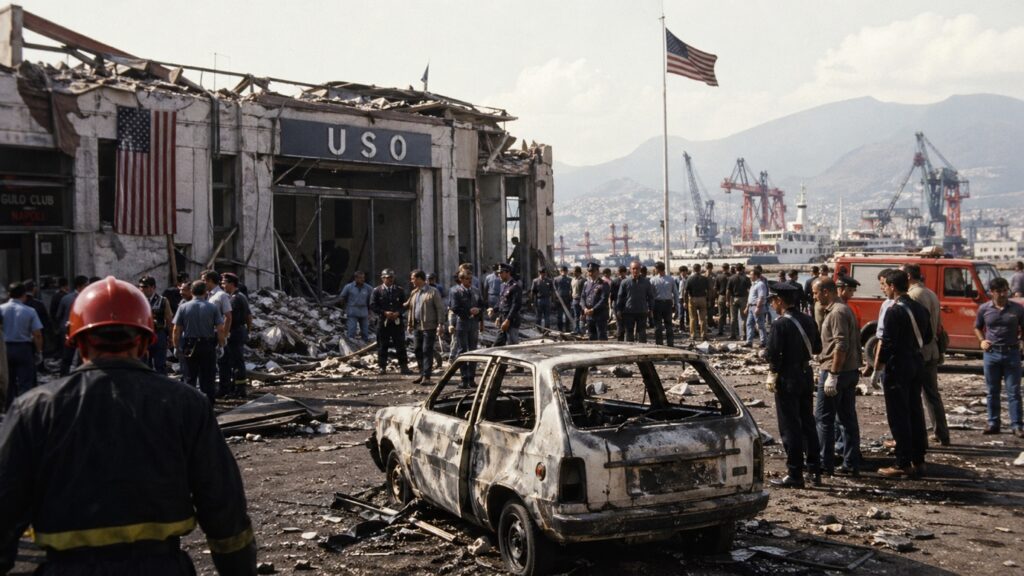
There is a page of Italian history that seems more repressed than forgotten. It’s the Naples massacre of April 14, 1988, when a Ford Fiesta loaded with explosives, nuts, and bolts exploded in front of the USO American recreational club in Calata San Marco, just steps from Piazza Municipio. Five people were killed, fifteen others injured. The culprit was neither the Camorra, nor the Red Brigades, nor a group from the Italian Years of Lead. It was a man from far away: Junzo Okudaira, a member of the Japanese Red Army, one of the most alarming ghosts of international terrorism in the second half of the 20th century.
This bombing was not an isolated event. It was the culmination of a network connecting Tokyo, Beirut, the Bekaa Valley, Tripoli, Rome, and Naples. A network where revolutionary ideology, the Palestinian cause, state sponsors, Middle Eastern logistics, and European vulnerabilities intertwined in a single geography of political violence. Even before the talk of globalization, terrorism was already global.
Also read: ECONOMY – Iran: Energy as an expanded front of war
The Japanese Red Army and the homeland-less revolution
The Japanese Red Army was born in the radical climate of post-war Japan, student protests, anti-Americanism, and extreme Marxism-Leninism. Japan in the sixties was not just the country of economic miracles, industry, productive discipline, and alliance with Washington. It was also a laboratory for political radicalization. The Zengakuren, a student movement orbiting communism, gave rise to a generation convinced that the security treaty with the United States symbolized national subordination.
From this galaxy emerged the Sekigun-ha, the Red Army Faction, which dreamed of a global armed revolution. But the real turning point came with Fusako Shigenobu, a central and almost mythological figure of Japanese terrorism. Daughter of defeated and humiliated Japan, educated at the university and in activism, Shigenobu brought the struggle beyond national borders. In 1971, she arrived in Lebanon, in Palestinian camps, and transformed a small Asian organization into a player in international terrorism.
Her intuition was simple and terrible: a revolution without territory could become more dangerous than a guerrilla rooted in a single country. Few militants, but trained, mobile, invisible, capable of using unsuspecting passports and striking symbolic targets on multiple continents.
The Palestinian knot and the first multinational of terror
The power of the Japanese Red Army did not lie in numbers. It lay in its alliances. The focal point was the Popular Front for the Liberation of Palestine and especially the structure led by Wadi Haddad, a Palestinian doctor and grand architect of external operations. Haddad understood that Arab terrorism, symbolic attacks, and cooperation between ideologically similar groups could transform the Palestinian struggle into a global war of images, hostages, and fear.
The Japanese Red Army provided the Palestinian network with something valuable: non-Arab militants, difficult to intercept at security checkpoints of the time, capable of crossing borders and airports with less suspicion. In return, they received training, weapons, documents, logistical cover, and funding.
The Lod airport massacre on May 30, 1972, was the baptism of blood: three Japanese militants opened fire in the Tel Aviv terminal, killing twenty-six people. A new form of terrorism was born: no longer just national, no longer just ideological, but networked, mobile, transnational.
Italy as a rear base and target
Italy entered this story not by chance. In the seventies and eighties, the country was both a target, rear base, and crossroads. It had experienced internal terrorism, the Red Brigades, political violence, ambiguous relations with the Mediterranean, American and NATO presence, the weight of the Palestinian issue, and the role of states like Libya and Syria in supporting different armed circuits.
There is no definitive evidence of direct operational alliance between the Red Brigades and the Japanese Red Army. It would be misleading to overstate the case. But there is an environmental, network, and mediation connection. The Popular Front for the Liberation of Palestine and the galaxy of Wadi Haddad provided a point of contact between different organizations. The Red Brigades obtained weapons through Middle Eastern and Libyan channels. The Japanese Red Army found its operational sanctuary in the same geopolitical area.
In this perspective, the Cold War was not just a state confrontation. It was also a circulation of weapons, protections, training camps, fake documents, ideologies, and money. International terrorism lived in the folds of the bipolar balance, exploiting the ambiguity of the states that protected, tolerated, or used it.
Rome 1987: the signal before the massacre
Before Naples, there was Rome. In June 1987, while Italy hosted the G7 summit in Venice, two attacks struck the American and British embassies in the capital. No casualties, but a very clear message: while Western leaders discussed security and terrorism, the network of the Japanese Red Army showed that it could act at the heart of Europe.
The name used, “Anti-Imperialist International Brigades,” was not coincidental. In Italy, the word “Brigades” immediately evoked the Red Brigades. This choice created confusion in the early stages of the investigation but also a symbolic continuity: the idea of an international revolutionary brotherhood against the United States, the United Kingdom, Israel, and Western allies.
Junzo Okudaira was identified as the material executor but managed to disappear. A year later, he reappeared in Naples.
Also read: Editorial – Japan and immigration: When demographics do not justify abandoning sovereignty and identity
Naples, the military gateway to the Mediterranean
Why Naples? The answer is strategic. Naples was not just a large Italian city in the South. It was a military, Atlantic, Mediterranean city. Home to important structures related to the American naval presence and NATO, it was a hub for American projection in the Mediterranean. Striking Naples meant striking America not on American soil but within one of its European platforms.
The chosen date, April 14, 1988, reinforced the political message: the second anniversary of the American bombing of Tripoli and Benghazi in 1986. The target was the USO club, a meeting place for American military personnel. The attack aimed to address Washington, Rome, Tripoli, Beirut, and the entire Western system.
The military logic was clear: symbolic target, simple but deadly explosive charge, maximum media exposure, quick escape, and claims through code names. Most American military personnel survived because they were in the basement of the building. Those who died were mostly people present in the blast radius. As often happens in terrorism, the political symbol was built on the bodies of random victims.
The geopolitics of the massacre
The massacre of Calata San Marco reveals a truth often repressed: the Mediterranean Italy was exposed to conflicts it did not control. Its geographical position, American presence, relationship with the Arab world, proximity to Libya, NATO’s weight, and internal fragility made it an ideal target.
From a geopolitical perspective, Naples was hit because it was a gateway. A military gateway from the United States to the Mediterranean, an Italian gateway to North Africa, a symbolic gateway of a Europe traversed by wars fought elsewhere. International terrorism acted precisely in these gaps: where sovereignties overlap, where apparatuses cooperate but do not always communicate, where the enemy arrives through an unforeseen trajectory.
From an economic standpoint, the incident anticipates a theme that is central today: the security of infrastructures and strategic nodes. Ports, naval bases, logistical cities, energy corridors, communication centers, are never just civilian locations. They are sensitive points of the international order. Naples was then, as are today maritime straits, submarine cables, energy ports, digital platforms.
A ghost that Italy repressed
The bitterest part of this story is its repression. For decades, the Naples massacre remained on the fringes of public memory. It did not fully belong to the narrative of Italian Years of Lead, did not fall under the Camorra memory, could not be explained by the usual categories of domestic terrorism. It was too international, too abnormal, too disturbing.
Junzo Okudaira remained a ghost. Sentenced to life imprisonment in Italy, also wanted by the United States, regarded for years as the main fugitive by the Naples prosecutor’s office, he continues to embody the unresolved nature of that season. Not just because he was not captured, but because he forces us to see Italy as the stage of a broader war.
The plaque installed in 2021 at Calata San Marco restored at least some public visibility to the victims. But memory cannot be limited to the stone. It must become historical understanding.
The forgotten lesson
The Naples massacre of 1988 teaches us that terrorism never arises in a vacuum. It requires ideology but also logistics. It needs fanaticism but also passports, bases, money, covers, accommodating states, and international networks. The romantic figure of the armed militant is a lie. Behind the terrorist act, there are always infrastructures, protections, calculations, interests.
The Japanese Red Army was small in number but immense in its ability to move in the fault lines of the international system. Naples was one of its bloodiest traces. And perhaps that is precisely why we must remember: because it shows that Italy was not only the center of its own domestic terrorism but also the target of a proxy war fought with ideology and vengeance.
Today’s world is different, but no less exposed. Networks have changed, instruments have evolved, ideologies have transformed. Instead of cells trained in the Bekaa, there are new jihadist pipelines, criminal networks, hybrid actors, digital mercenaries, informal devices, and cyber campaigns. But the logic remains the same: strike where the enemy believes he is protected, use symbolism, exploit gray areas, turn a city into a message.
Naples, on April 14, 1988, was that: not just a forgotten massacre but a window into the dark side of Mediterranean Cold War. A war of bombs, ghost codes, sponsoring states, professional revolutionaries, and innocent victims. A war that Italy too quickly archived, perhaps because recognizing it would have meant admitting a disturbing truth: our country was not just at the margins of the world terrorism history. It was one of its crossroads.
Also read: ECONOMY – The routes of low-cost goods from Asia to Europe: Between geopolitics, tariffs, and US-China trade war




/2026/05/03/69f7168f916d9345723965.jpg "F1: Kimi Antonelli on pole position for Miami Grand Prix with race start moved up three hours due to weather conditions")

