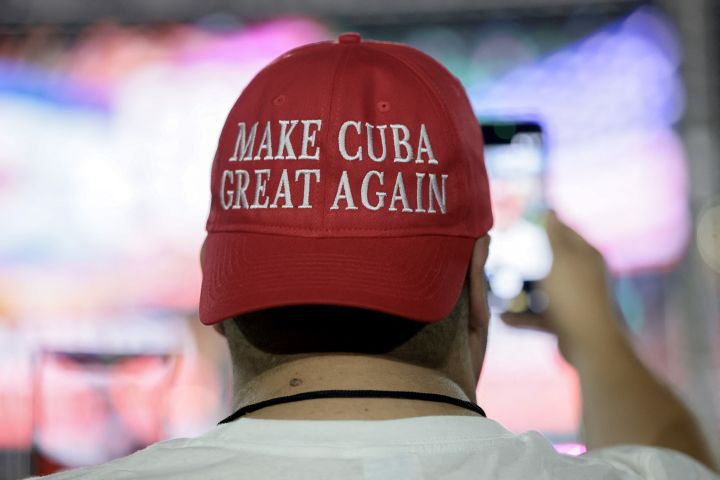
The Cuban diaspora will be able to invest in and own businesses in Cuba, announced Havana on Monday, which is in talks with the United States.
President Donald Trump has spoken about “taking” Cuba “one way or another,” without specifying exactly what he meant by that verb. He also said he wanted to “free” the island, during an exchange with journalists in the Oval Office of the White House in Washington.
Later in the day, Havana announced that Cubans residing abroad, especially in the United States, would be able to invest in the island, whose economy is on the brink, paralyzed by the energy blockade imposed by Washington. They will be able to own their own businesses there, the government clarified.
“Cuba is willing to have a smooth commercial relationship with American companies,” as well as “with Cubans residing in the United States and their descendants,” said Oscar Perez-Oliva Fraga, the Minister of Foreign Trade and Foreign Investment, in an interview with the American channel NBC.
This announcement comes at a time when the economy of the island, already weakened by over six years of crisis, is being further paralyzed by the energy blockade imposed by Washington, in addition to sanctions within the embargo in effect since 1962.
On Monday, the country experienced a new widespread power outage, the sixth in less than a year and a half.
The American embargo “deprives us of access to financing, technology, markets, and in recent years, its goal has been particularly to prevent our country from accessing fuel,” the minister stated.
Since mid-January, the republican president has claimed that talks are ongoing with Cuba, which the island finally acknowledged on Friday after denying for weeks that such contacts were taking place.
Cuba’s situation has worsened since the capture in January of Venezuelan President Nicolas Maduro by American forces, and the end of oil shipments that Caracas was sending to its ally. Donald Trump also threatens retaliation against any country that sends oil to the Caribbean island.
– Infrastructure –
With no oil tanker having arrived on the island for over two months, key sectors such as tourism, nickel extraction, agriculture, and tobacco are being severely affected by energy restrictions.
These investments go “beyond the commercial sphere,” the Cuban minister explained. “This applies to investments, not just small investments, but also significant investments, especially in infrastructure,” he added.
The goal of this opening, according to the minister, will be to revive tourism, mining, and to restore the aging electrical network of the island.
The announcement from Havana “suggests that this measure aims to prepare negotiations with the United States on American investments in Cuba, rather than to stimulate the economic participation of migrants,” economist Pedro Monreal opined.
In Miami, where the largest community of Cuban migrants resides, this announcement does not generate much enthusiasm.
“I don’t believe that we Cubans, neither those in the Miami diaspora nor those in any community around the world, will invest a penny in a Cuba oppressed by a regime that has deprived us of everything,” reacted Conchis Reyes, 60, born in Cuba, to AFP.
Ramon Fernandez, another Cuban native, lays down his conditions: “Yes, we want to invest there, but when there is an economic and political change,” he said.
While 80% of the island’s economy was still based recently on a planned and centralized production system by state enterprises, the crisis has pushed the government to further open up to the private sector.
Authorized five years ago, 10,000 small and medium-sized enterprises represented 15% of the GDP and over 30% of the workforce in 2025.
In early March, the Cuban government also adopted a decree establishing a legal framework to create joint ventures between state entities and private actors, a first on the island.
Until now, the only existing joint ventures were between the Cuban state and foreign, non-American companies.