Reproductions of Iranian missiles on display in front of the Defense Museum in Tehran on March 31, 2026 (AFP / -)
Donald Trump assured on Wednesday that the Iranian president was calling for a ceasefire, but ruled out any truce without opening the Strait of Hormuz, a strategic passage for Middle Eastern oil, the blockage of which by Iran destabilizes the global economy.
The remarks by the American leader on his Truth social network come ahead of a scheduled address at 9:00 PM (01:00 GMT Thursday). On Tuesday, Mr. Trump, alternating between reassuring and bellicose comments, mentioned the end of the war within “two, perhaps three weeks.”
According to him, Iranian president Massoud Pezeshkian “has just called for a CEASEFIRE.” In the same post, Mr. Trump wrote that he will only consider it “when the Strait of Hormuz is open, free, and clear,” otherwise, Iran will be bombed “until annihilation.”
The war triggered on February 28 by American-Israeli strikes on Iran has caused thousands of deaths, shaken the global economy, led to Iranian bombings of Gulf countries and Israel, and sparked new clashes in Lebanon between Israel and the pro-Iranian Hezbollah movement.
The Iranian Revolutionary Guards, the ideological army of the Islamic Republic, asserted that the Strait of Hormuz would remain closed to the country’s “enemies.”
The Iranian president had mentioned on Tuesday a desire “to end” the war but demanded guarantees and reiterated requests such as financial compensation.
Economies battered
In the meantime, new bombings have rocked the Iranian capital, causing damage to the perimeter wall of the former American embassy, a symbolic site of hostility between the two countries.
Regarding the Strait of Hormuz, through which a fifth of the world’s oil usually passes, Mr. Trump stated on Tuesday that its blockage was no longer his concern, before finally conditioning a ceasefire on its reopening on Wednesday.
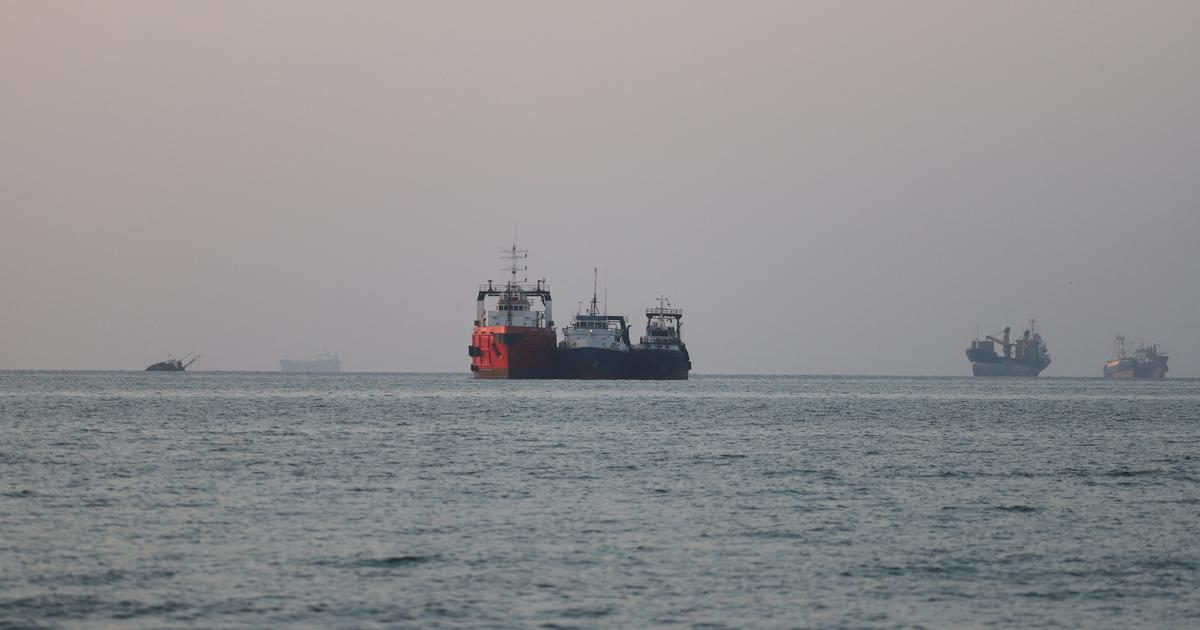
This maritime passage is essential to the global economy, and its closure has caused a surge in oil prices and energy, fueling fears of sustained inflation.
The Revolutionary Guards confirmed on Wednesday that they had attacked a tanker in the Gulf, claiming it was Israeli. Qatar had earlier indicated that the ship belonged to Qatar Energy and was hit in its territorial waters.
The United Kingdom announced this week that it is convening around thirty countries to coordinate efforts to restore maritime transport.
Boosted by hopes of de-escalation following Mr. Trump’s comments on Tuesday, the markets rebounded in Europe in the midday. At the same time, the price of Brent crude oil dropped below $100 per barrel.
The economic repercussions of the conflict, however, continue to be felt.
Australian Prime Minister Anthony Albanese warned his compatriots of “difficult months ahead” due to the energy impact of the war.
Powerful explosions in Tehran
In Germany, major economic institutes have assessed that the conflict is hindering the German economic recovery, with growth projected at 0.6% in 2026, halving the previous forecast.
The Gulf countries have been targeted by new Iranian attacks. In the Emirates, a Bangladeshi was killed and an Indian national injured by debris after the interception of drones. The Kuwait National Bank announced the closure of its headquarters for two days due to strikes.
Israel, in turn, continued its bombardments of Iran, announcing a “wave of massive strikes” in the capital.
PowUrful explosions were heard Wednesday afternoon in western Tehran, according to an AFP journalist. State television had earlier reported detonations in the north, east, and center of the city.
In addition to the wall surrounding the former American embassy, residential buildings were hit by strikes, causing several injuries according to the Mehr agency.
In the capital, thousands of Iranians attended the funeral of the commander of the Revolutionary Guards’ navy. A sign held by a child reads “Vengeance” in English.
The Israeli government, on its part, believed that part of its objectives had been achieved by delivering “a severe blow to two existential threats,” namely the Iranian nuclear and ballistic programs.
The campaign is not over
“The campaign is not over,” insisted Israeli Prime Minister Benjamin Netanyahu.
Israel also continued to be targeted by Iranian missile attacks, with reports of 14 injuries.
In Tel Aviv and its surroundings, AFP observed children being cared for by emergency services, damaged cars, and shattered windows on the second floor of a residential building.
Israel also faced a new Houthi attack, a rebel group allied with Tehran, their third since joining the conflict on Saturday.
In Lebanon, the toll from a month of Israeli strikes has now exceeded 1,300 deaths, according to the Ministry of Health. The government reported seven deaths in the Beirut region on Wednesday. A senior Hezbollah official was killed in a bombing.
/2026/06/11/6a2a9f7b81682965328303.jpg "British Defense Minister John Healey resigns to oppose the next defense investment plan which he considers insufficient")