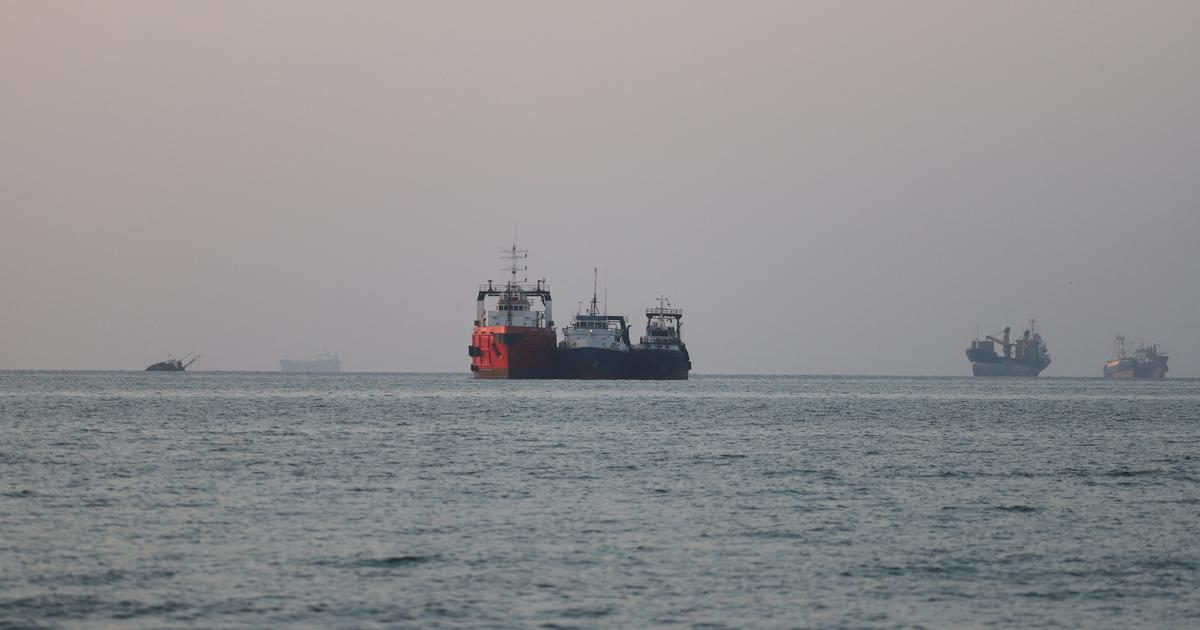
After Kharg Island, it was the Iranian island of Qeshm that was hit by strikes on Tuesday, March 31.
- Why such operations on these small pieces of land?
- TF1info looked into the question.
Follow complete coverage
One month of war in the Middle East
Donald Trump threatening to “wipe out” Kharg, or strikes hitting the desalination plant on the Iranian “riviera” Qeshm… In recent weeks in the war in Iran, the United States and Israel have intensified their operations against parts of the Islamic Republic’s islands.
In the region, especially in the strategically vital Strait of Hormuz, the regime of the mullahs reigns over several small pieces of land, some heavily militarized. These “pebbles in the shoes” of the United States and Israel, Jehan-Christophe Charles, a researcher associated with the Mediterranean Foundation for Strategic Studies (FMES), pointed out.
Qeshm: Iran’s Pearl
Among these “pebbles,” Qeshm stands out as Iran’s Pearl, the largest island in the Gulf stretching over a hundred kilometers in the Strait of Hormuz, a few kilometers from the coast of the Islamic Republic. A popular tourist destination with UNESCO-classified heritage, it serves as one of the entry points for products from the Emirates.
But what interest does Israel and the United States have in their war against Iran? Jehan-Christophe Charles suggests, “It could allow them to have a better view of what is happening in the strait, even if taking an island like Qeshm would be more symbolic.”
Larak: The Gateway to Hormuz
Furthermore, Qeshm is near other Iranian islands: Larak and Hormuz, located in the narrowest point of the strait and militarized by the Islamic Republic. Larak, with a military base of the mullah regime, holds a strategic position due to its maritime route regulated by the Revolutionary Guards for select commercial ships.
While Larak may be crucial for maritime traffic management, its military significance is limited in the context of the war. Jehan-Christophe Charles suggests, “If the island is heavily militarized, it seems to serve no purpose for Iran. The country has intelligence means, including assistance from Russia, to gather information offshore and does not need men with binoculars on an island to know what is happening in the strait.”
Small Tomb, Big Tomb, and Abu Musa: Disputed Lots
In the region, Iran also controls three more islands further from its coast: Small Tomb, Big Tomb – about 20 km from Qeshm, with the second covering an area of 10 km² – and Abu Musa, the southernmost island in the Persian Gulf at 12 km². These territories are contested, also claimed by the United Arab Emirates and turned into mini-fortresses by the mullah regime.
While these islands were strategically important when taken in 1971 by the Shah of Iran for striking and monitoring neighboring countries, advancements in technology and Iranian missiles and drones have reduced their military value.
“They no longer have crucial strategic importance but still pose threats in operations, with a nuisance capability that can complicate operations if neglected. Taking one island, like Qeshm, would require taking them all or leaving behind potential hurdles,” analyzes Jehan-Christophe Charles.
Kharg: The Key to Ending the War?
Beyond military strategy, the symbolic significance could make Iranian islands a focal point in the ongoing war in the Middle East. A US military operation on Qeshm or Kharg and their capture could deal a severe blow to the mullah regime and serve as leverage to compel Tehran to cease threats against global maritime traffic in the strait of Hormuz. This could potentially enable the United States, under Donald Trump, to claim victory.
For now, as Iran shows no signs of weakening and Washington seeks an exit strategy, “everyone is playing a game, a bit like a game of poker,” analyzes Jehan-Christophe Charles. “At some point, they will have to show their cards to resolve this crisis.” A card that, from the American side, could be called Kharg or Qeshm.