All American presidents end up leading a major military campaign.
Source: Foreign Policy, Stephen M. Walt
Translated by readers of the Les-Crises website
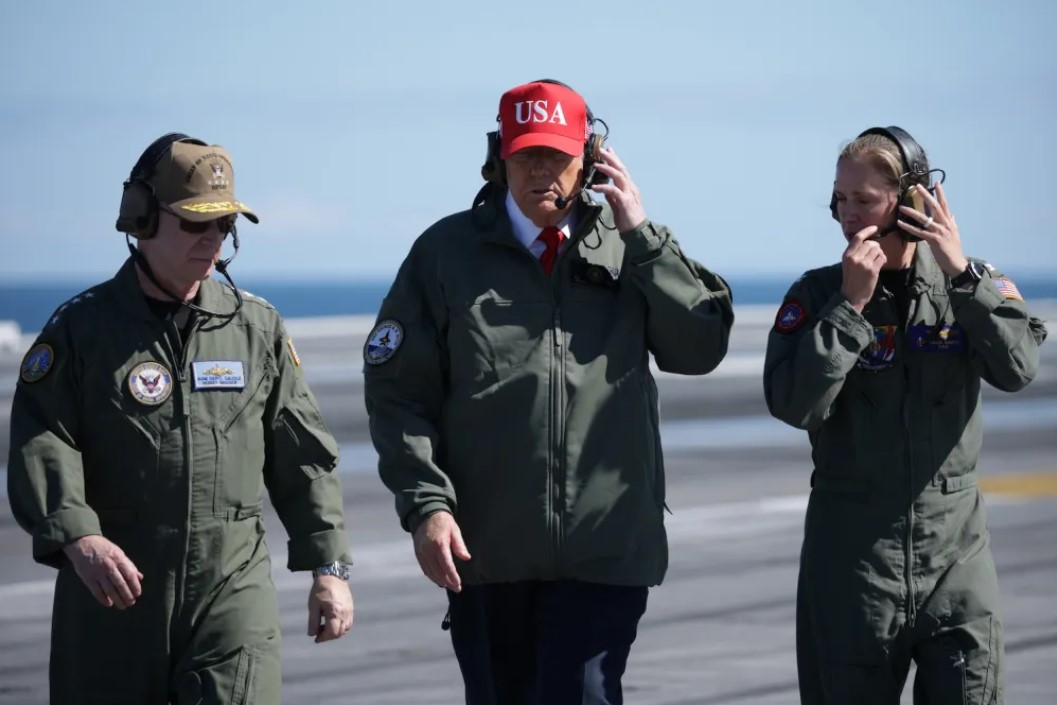
- President Donald Trump attends naval air demonstrations on the flight deck of the USS George H.W. Bush aircraft carrier on October 5, 2025, off the east coast of the United States. Alex Wong/Getty Images
By Stephen M. Walt, columnist at Foreign Policy and professor of international relations at Harvard University, holder of the Robert and Renée Belfer Chair.
Despite what they say, American presidents find it impossible not to go to war. In 1992, Bill Clinton won the presidency by declaring “It’s the economy, stupid” and announcing the end of the era of power politics. However, once in power, he was forced to order missile strikes in several countries, maintain no-fly zones over Iraq (and sometimes bomb it), and conduct a long aerial campaign against Serbia in 1999.
In 2000, George W. Bush won the White House by criticizing Clinton’s hyperactive foreign policy and promising voters a strong but “humble” foreign policy. We all know how that turned out. Eight years later, a young senator named Barack Obama became president largely because he was one of the few Democrats to oppose the Iraq invasion in 2003. Less than a year into his tenure, he received the Nobel Peace Prize without having done anything to deserve it, simply because people believed he would be a staunch advocate for peace. Obama certainly tried his hand at several issues and eventually reached an agreement to reduce Iran’s nuclear program, but he also launched an unnecessary “surge” in Afghanistan, contributed to the overthrow of the Libyan regime in 2011, and became increasingly comfortable authorizing targeted strikes and assassinations against a series of targets. By the end of his second term, the United States was still at war in Afghanistan and far from achieving victory.
Then, a mediocre businessman and reality TV star named Donald Trump ran for the presidential election in 2016, openly condemning “endless wars”, denouncing the foreign policy establishment, and promising “America first”. After an unexpected electoral victory, he also announced a temporary reinforcement of troops in Afghanistan, continued full force in the global war on terrorism, ordered the missile assassination of a top Iranian official, and presided over a steady increase in the military budget. Trump did not start any new wars during his first term, but he did not end any either.
Joe Biden, on the other hand, ended a war when he put an end to the futile American campaign in Afghanistan, and he was criticized for taking into account the realities that his predecessors had ignored. Biden orchestrated a vigorous Western response to Russia’s illegal invasion of Ukraine in 2022, but most observers overlooked the fact that his previous efforts to bring Ukraine closer to the Western orbit had made war more likely. After ignoring the Palestinian issue in his first two years in office, Biden provided billions of dollars in arms and diplomatic protection to Isreal in response to the Hamas genocidal attack on Isreal in October 2023.
Biden’s mistakes (and his insistence on winning a second term) helped Trump return to the Oval Office, once again promising to be the president of peace and to end the permanent interventionism that has cost Americans trillions of dollars and thousands of lives. But instead of radically breaking from the past, Trump 2.0 has proven even more eager to pull the trigger than the presidents he used to mock. The United States bombed at least seven countries in his first year in office, ruthlessly killed boat crew members in the Caribbean and Pacific on mere suspicion of carrying drugs, kidnapped the leader of Venezuela to take control of the country’s oil (while leaving the country in the hands of a new dictator), and just launched their second war against Iran in less than a year. After declaring to the world that Iranian nuclear facilities had been “destroyed” last year, he now claims the US had to bomb them to end “imminent threats”.
What is the problem here? Since 1992, a succession of presidents from both parties have run for elections promising to be peacemakers and avoid the excesses and mistakes of their predecessors, but once in power, they can’t resist the urge to blow everything up in distant lands. Once again, we have to ask the question: are the United States addicted to war?
Before Trump’s second term, this pattern could be explained by the ambitious goals of the “Blob”, that influential bipartisan group in foreign policy that viewed military force as a useful tool to promote a liberal world order. But this rationale hardly explains Trump’s decisions during his second term. He continues to despise the establishment (aka “deep state”), blames it for the failures of his first term, dismantled the bureaucratic apparatus responsible for national security, and appointed loyalists to key positions to obey his orders. This latest war cannot be attributed to the Blob.
Advocates of these policies could argue that the United States has unique global responsibilities and that even if presidents come into power with idealistic ideas about reducing the use of force, they quickly understand the need to use American power worldwide. The problem with this explanation is that blowing things up so frequently rarely solves underlying political problems, does not make the US safer, and is certainly not good for most of the countries we have bombed. Even a country that takes as long as the US to learn should have figured that out by now. The question then remains: why does Washington continue to act this way, even under the presidency of a man who would like to win a real Nobel Peace Prize (not just the fake one awarded by FIFA)?
One obvious reason can be found in the long-term strengthening of the executive branch, which has been ongoing since the beginning of the Cold War and has been further amplified during the war on terrorism. We have given presidents wide latitude in decisions related to war and peace, in conducting diplomacy, in the activities of a sprawling intelligence apparatus, and in covert action capabilities. We have tolerated a certain opacity that makes it easier for the executive to lie when necessary. Presidents from both parties have been all too happy to accept this freedom of action and have rarely welcomed efforts to reduce their powers. The consolidation of executive power has been aided and encouraged by Congress, which has become less and less willing to exert significant control over decisions to use force. So when the Obama administration actively sought a new authorization for the use of force (to replace outdated resolutions that had authorized the war on terror and the invasion of Iraq), Congress refused to grant it because its members did not want their position officially recorded. And today, they complain that the Trump administration did not seek their authorization before deciding to launch a new unjustified war against Iran.
A second reason, as both Sarah Kreps and Rosella Zielinski have shown, is that American presidents are free to declare war because they have learned not to ask the American people to fund it in real time. The Korean War was the last war that directly led to tax increases. Since then, presidents have only borrowed the money needed, leaving the deficit to increase further and leaving future generations to foot the bill. As a result, most Americans do not feel the economic repercussions of long and costly campaigns like the wars in Iraq and Afghanistan, which have cost at least 5 trillion dollars.
An army entirely composed of volunteers also simplifies the decision-making process on war, as those sent into combat have all opted for this possibility and are less likely to complain than randomly selected draftees. It also allows elites like Trump (and his children) to completely avoid military service, limiting the impact these decisions can have on the rich and influential and gradually transforming the professional army into a distinct caste, less connected to the society it is supposed to defend. But do not blame the military for these recurring decisions to use force, it is the civilians who pull the strings.
You can, however, blame the military-industrial complex. Note: I’m not saying that Lockheed Martin or Boeing pressured to go to war with anyone, but when your business is selling weapons, then your business is also selling insecurity. This entails painting a world full of threats (some of which should be anticipatable), a world where diplomacy is devalued and kinetic solutions are overestimated. It is no coincidence that defense companies are prominent supporters of many foreign policy think tanks, which often try to convince Americans that threats are omnipresent, that the US may need to take military action to address them, wherever they are on the planet, and that increasing defense budgets is the obvious solution. Once you have all these possibilities, it can be difficult to resist the temptation to use them. There are also special interest groups, like AIPAC (American Israel Public Affairs Committee) and the hawks of the Israeli lobby, who sometimes succeed in convincing presidents to rally to their cause and persuade the fragile leaders in Congress not to oppose it.
There is one last reason why American presidents have become addicted to war: the use of force has become too easy and apparently risk-free. Cruise missiles, stealth aircraft, precision-guided bombs, and drones have allowed the US (and a few other countries) to conduct massive aerial campaigns without sending troops to the ground and without worrying too much about direct retaliation (at least initially). Iran may retaliate against the US or its allies in various ways, but it cannot hope to inflict the same level of damage on US soil as Washington can inflict on it. Consequently, when faced with a thorny diplomatic challenge or when looking for a way to divert attention from national problems or scandals (Jeffrey Epstein, ring a bell?), it can be extremely tempting to resort to the military option. Or as Senator Richard Russell, not a pacifist, said in the 1960s: “There is reason to believe that if it is easy for us to go anywhere and do anything, we will always go somewhere and always do something.”
At times I see it as the “big red button” problem. It’s as if every president has one on his desk, and when foreign policy problems arise (or when attention needs to be diverted), his advisors come into the Oval Office to present the situation to him. They point out that pressing the button will show his determination, prove that he is acting, and could have a positive impact. If they are honest, they may acknowledge that it is not absolutely necessary to press the button and that it could worsen things. But they will remind him that the risks are low, the costs are reasonable, and if he does not press the button, the problem will almost certainly worsen and he will appear indecisive. They conclude the meeting solemnly: “It’s up to you to decide, Mr. President.” Leaders with better judgment than most recent presidents would be needed to resist such flattery in the long term.
To be clear, this latest wave of violence is the least justified bloodshed by the American military since the invasion of Iraq in 2003. But what it reveals about America’s addiction to war is at least as important as what it teaches us about the current American president.
Were bone spurs not a way to avoid the draft? Trump himself would not be eligible for military service, would he? [A doctor in Queens had stated that President Donald Trump suffered from bone spurs to help him avoid the draft during the Vietnam War, as a “favor” to his father Fred Trump, Ed. Note]
Source: Foreign Policy, Stephen M. Walt, 02-03-2026