Long relegated to the background in energy debates, nuclear power is making a strategic comeback in public policies worldwide. The combination of successive energy crises, volatile hydrocarbon markets, and climate urgency has profoundly changed the perception of this energy source, now considered as a tool to reconcile energy sovereignty and carbon emission reduction.
Nuclear energy: 10% of global electricity production
Today, nuclear energy accounts for approximately 10% of global electricity production, according to official data from the International Atomic Energy Agency. More importantly, it represents nearly a quarter of low-carbon electricity produced worldwide, a major asset in the race for climate neutrality. This characteristic makes it a so-called “dispatchable” energy, capable of providing stable production, unlike intermittent renewable energies like solar or wind.
This repositioning is part of a strong political dynamic. During COP28, more than twenty countries supported an ambitious goal: to triple global nuclear capacities by 2050. “We know by science, realities, and evidence that we cannot achieve carbon neutrality by 2050 without nuclear,” stated John Kerry during the event in Dubai. This direction reflects a notable evolution in energy strategies, where nuclear power is now seen as complementary to renewables in hybrid electrical systems.
A lever of sovereignty
Beyond climate issues, the geopolitical dimension plays a decisive role. International tensions and disruptions in supply chains have highlighted the vulnerability of states dependent on fossil fuel imports. In this context, nuclear power appears as a lever of sovereignty, allowing to secure long-term domestic electricity production.
However, this revival comes with major structural challenges. The cost of infrastructure remains high, with initial investments reaching multiple billion dollars per reactor. In addition, issues of construction delays, radioactive waste management, and social acceptance continue to hinder some projects, especially in Europe.
To address these constraints, technological innovation plays an increasing role. Small modular reactors (SMRs) are of particular interest. Smaller, potentially less expensive, and quicker to deploy, they could facilitate access to nuclear power for emerging countries or medium-sized electrical networks. Several pilot projects are currently in development, supported by states and industries.
Simultaneously, international institutions are strengthening their regulatory role. The International Atomic Energy Agency remains a central player in ensuring the safety, security, and peaceful nature of nuclear programs. It also supports countries wishing to develop nuclear capacities, notably through regulatory frameworks and training programs.
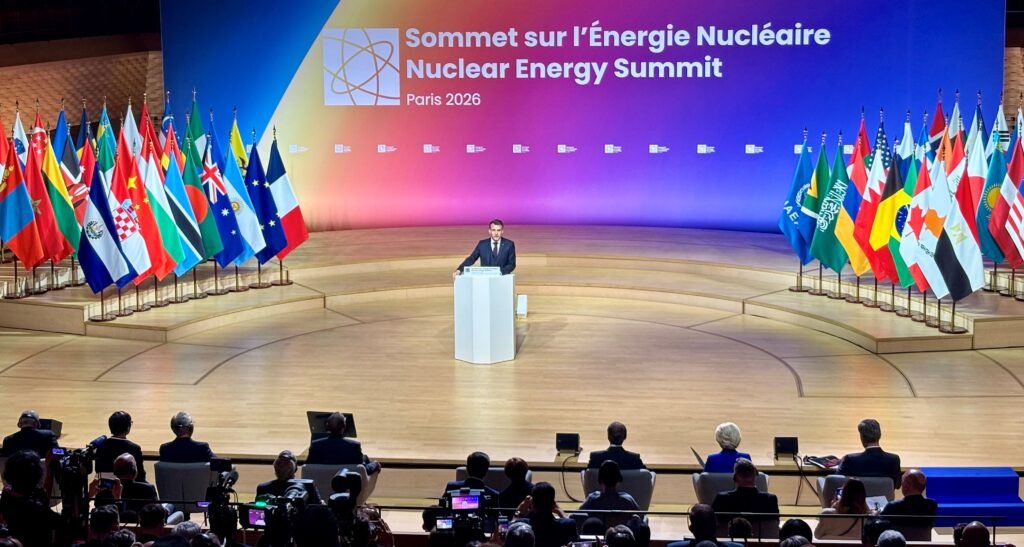
The second global summit on nuclear energy, held on March 10, 2026, in Paris by France and the IAEA, is part of this overall dynamic. It confirmed the increasing willingness of a growing part of the international community to reposition nuclear power as a pillar of future energy systems, complementing other low-carbon energy sources.
Africa: Growing but still emergent interest
In Africa, the development of civilian nuclear power is still in its infancy, but signals of interest are multiplying. To date, only South Africa has an operational nuclear power plant, Koeberg. However, several countries are actively exploring this option to meet the rapidly increasing demand for electricity.
Rwanda is among the states engaged in this strategic reflection and participated in the Paris summit. President Paul Kagame stated that “nuclear will diversify our energy mix while providing the stability required for industrial growth and long-term transformation.” Kigali is developing an ambitious roadmap, particularly around modular reactor technologies and micro-reactors, in partnership with international actors. The goal is to diversify its energy mix and secure its long-term supply.
In a continent where more than 600 million people still lack access to electricity according to the World Bank, nuclear power could eventually be a complementary solution to renewables to support industrialization and economic growth. However, its deployment will depend on many factors: financing capacity, regulatory stability, technical skills, and public acceptance.
Nuclear energy energy transition decarbonization energy sovereignty AIEA COP28 climate innovation SMR Africa Rwanda World Bank energy security energy policies




/2026/06/11/6a2adcc83a0a9970169772.jpg "Strikes in the Middle East: the CGT of merchant navy officers denounces facts \"extremely serious\" and does not exclude an evacuation of French sailors")
/2026/06/03/6a1fe03069270315959679.jpg "Programme Coupe du monde 2026 : Mexique-Afrique du Sud, Corée du Sud-Tchéquie… A quelle heure et sur quelles chaînes suivre les matchs du jour et de la nuit de jeudi à vendredi")